Coffee and Liver Health: What the Science Actually Shows

You’re tired of vague wellness advice that never quite connects to how you actually feel. Maybe you’ve had elevated liver enzymes flagged on a routine panel, or you’re managing fatty liver and wondering what lifestyle changes genuinely matter.
Here’s something the research keeps pointing to: that daily cup of coffee may be doing more for your liver than you realize.
The evidence on coffee and liver health has been building steadily for decades — across countries, across conditions, and across brewing methods. What started as a curious finding in a 1986 Norwegian study has since been replicated in the US, Italy, Japan, and Mexico. The consistency across such different populations is what makes this association worth taking seriously.
☕ Quick Wins: Coffee and Your Liver
- 2–4 cups per day is the range most often associated with liver-protective effects in observational research
- Both caffeinated and decaffeinated coffee may offer benefits — the antioxidants in coffee appear to play an important role alongside caffeine
- Filtered brewing (drip, pour-over) is generally preferred — paper filters remove oils that can raise LDL cholesterol
- Associations have been observed in people managing NAFLD, hepatitis C, and elevated liver enzymes
- Adding large amounts of sugar or cream daily may offset metabolic benefits, particularly for those managing fatty liver
In This Article
What Coffee Actually Does for the Liver
Regular coffee consumption is consistently associated with lower levels of liver enzymes — including ALT, AST, and GGTP — and a reduced risk of fibrosis, cirrhosis, and liver cancer across multiple large studies.[1]
The research on coffee and liver health is unusually consistent for a dietary topic. Most nutrition studies produce conflicting results depending on population and methodology. Coffee’s association with liver markers has held up across decades, countries, and disease states — which is notable, even if causality hasn’t been fully established.
This doesn’t mean coffee is a treatment. But for most adults, it appears to be one of the more liver-supportive daily habits in the research — particularly for those managing fatty liver or elevated enzyme levels.
What’s in Your Cup
Coffee contains over a thousand bioactive compounds. Caffeine is the most recognized, but it’s far from the only one that may be relevant to liver health.
Chlorogenic acids are among the primary antioxidants — a medium-roast cup delivers roughly 35 to 500 milligrams per 100 ml serving, depending on bean origin and roasting. These compounds are thought to interact with inflammatory pathways, though the exact mechanisms in human liver tissue are still being studied.
Beyond Caffeine: The Compounds That Matter
Cafestol and kahweol are diterpenes found mainly in unfiltered coffee — French press and Turkish coffee being the most common examples. These compounds have shown anti-inflammatory properties in some studies, but they also raise LDL cholesterol, which is why filtered brewing is generally preferred for people managing metabolic or cardiovascular health.
Trigonelline, another compound present in coffee, shows antioxidant activity in laboratory studies and may contribute to the liver enzyme associations seen in population research — though its specific role in humans is not yet well characterized. It breaks down during roasting, which may partly explain differences between light and dark roast profiles.
Does Roast or Brew Method Change Anything?
Roasting reduces chlorogenic acid content — lighter roasts retain more. The liver enzyme associations seen in population studies appear across roast levels, which suggests that multiple compounds are likely involved rather than a single active ingredient.
Decaffeinated coffee retains most of the antioxidant content. Whether decaf offers equivalent liver protection is a nuanced question — addressed directly in the next section.
What the Research Consistently Shows
The story starts in Norway, 1986. Researchers noticed that people who drank coffee regularly had lower GGTP levels — a liver enzyme often elevated in people with liver stress or alcohol use. At the time it was treated as a statistical curiosity.
Then studies from Italy, Japan, Mexico, and the US started showing the same pattern. The association proved durable across different populations and study designs.
By the time large-scale analyses became possible, the data was notable. A 2013 meta-analysis of epidemiological studies reported that coffee consumption was associated with a roughly 40% lower risk of hepatocellular carcinoma (liver cancer) compared to no consumption — though the authors noted that some of this association may reflect reduced coffee intake among people already experiencing liver disease.[6]
The US Multiethnic Cohort study found that drinking three or more cups daily was associated with a lower risk of liver cancer incidence and death from chronic liver disease compared to non-drinkers.[7] Findings from large European prospective cohorts have reported similar inverse associations. These are observational findings — they describe an association, not a proven causal effect.
One Thing Worth Pushing Back On Here
The assumption most people carry is that caffeine is doing all the work. That’s where the standard narrative oversimplifies.
Decaffeinated coffee shows broadly similar associations with liver enzyme levels in several studies — though the evidence is less extensive than for caffeinated coffee, and direct comparisons are limited. If caffeine were the sole driver, you’d expect a clearer gap between the two. The antioxidant compounds, especially chlorogenic acids, appear to contribute independently.[2]
In practice, this means: if you’ve switched to decaf for sleep or anxiety reasons, you may not be losing all of the liver-related association. But it would be an overstatement to say the two are equivalent — the evidence for caffeinated coffee is stronger and more consistent overall.

How Coffee May Protect the Liver
Two biological pathways are highlighted most consistently in the research. They help explain why coffee’s association with liver health appears across different conditions — though it’s important to note that much of the mechanistic evidence comes from laboratory and animal studies, with human data still building.
Antifibrotic Action
Fibrosis is the buildup of scar tissue in the liver — a gradual process that can progress to cirrhosis if the underlying cause isn’t addressed. In plain terms: healthy liver tissue gets replaced by stiff, non-functional scar tissue over time.
Some research suggests caffeine may inhibit the activation of hepatic stellate cells — the cell type primarily responsible for producing this scar tissue. In laboratory models, caffeine has been shown to reduce markers of fibrosis activity, including procollagen expression.[4]
Whether this translates directly to meaningful antifibrotic effects in humans at typical coffee consumption levels is still an open question. The population data showing lower fibrosis rates in coffee drinkers is consistent with this mechanism, but doesn’t confirm it as the cause.
Anti-Inflammatory Effects
One study measuring 77 different immune markers in approximately 1,700 adults found that regular coffee drinkers had lower circulating levels of several inflammatory proteins, including IFN-γ, FGF-2, and fractalkine. These are signaling molecules involved in chronic inflammation — the kind of low-grade, ongoing inflammation associated with liver damage over time.
Lower inflammatory signaling doesn’t eliminate an underlying liver condition, but it may reduce the pace of damage accumulation. This is a plausible mechanism, though it’s based on a single observational study and would need further replication.
There is also early-stage evidence suggesting coffee may support autophagy — the process by which cells clear out damaged components. This mechanism is primarily from laboratory research and remains exploratory in the human context.
Coffee and Fatty Liver Disease (NAFLD/MASLD)
NAFLD — now increasingly referred to as MASLD — is estimated to affect around 25–30% of adults in the US. Many people discover it incidentally when liver enzymes appear elevated on routine bloodwork. That moment of unexpected news is more common than most realize.
This is where the research on coffee and liver health has some of its more practically relevant implications.
The NHANES 2001–2008 analysis found that higher caffeine intake was independently associated with a lower prevalence of NAFLD — one of several lifestyle factors that showed this pattern in that dataset.[8]
For people already diagnosed with fatty liver, a multicentric clinical study found that higher coffee consumption was associated with less severe fibrosis — meaning those who drank more tended to have less advanced scarring. This association held after adjusting for several other variables, though residual confounding can’t be ruled out in observational data.
The proposed mechanisms include reduced inflammatory signaling, potential improvements in insulin sensitivity, and reduced fat accumulation in liver cells — though these pathways haven’t been confirmed in controlled human trials. If you’re managing fatty liver and looking at the full dietary picture, the MASLD diet guide covers the broader context well.
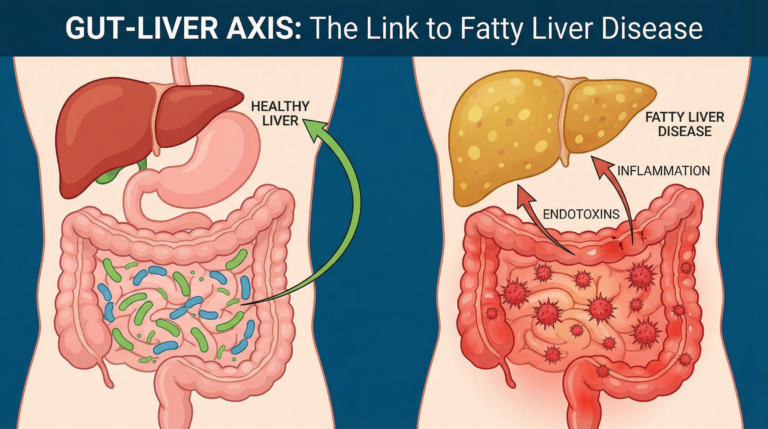
There is also some evidence that coffee consumption may influence gut microbiota composition in ways that could affect liver inflammation through the gut-liver axis — an area explored in more depth in the gut-liver axis article.
Coffee and Hepatitis B & C
For people managing a hepatitis diagnosis, the research on coffee adds some context — though the evidence here is more limited and should be interpreted cautiously.
Hepatitis C
Several observational studies have found that regular coffee intake is associated with slower disease progression in people with hepatitis C. The Modi et al. study of 177 patients undergoing liver biopsy found that those consuming more than approximately 2 coffee-cup equivalents of caffeine per day had lower fibrosis scores on average — though as a single study with a moderate sample size, these results require replication.[3]
In laboratory models, caffeine has been shown to inhibit hepatitis C virus replication in a dose-dependent manner. Whether this effect is clinically meaningful at normal coffee consumption levels in humans has not been established.
One detail worth noting: in the Modi study, the association held even after controlling for age, sex, BMI, and alcohol intake, which argues against the pattern being purely a marker of overall healthier behavior. Some research has also suggested better tolerability of antiviral therapies in regular coffee drinkers — but this evidence is preliminary and not sufficient to draw firm conclusions.
Hepatitis B
Evidence for hepatitis B is considerably thinner. Some experimental studies suggest certain coffee compounds may affect HBV-related pathways in laboratory models, but there is limited human clinical data. This remains an exploratory area rather than an established finding.
How to Make Coffee Work for Your Liver
The practical picture here is relatively straightforward — the habits associated with the liver benefit in research are already accessible for most people.
Start with brewing method. Filtered coffee — drip machine, pour-over, or Aeropress with a paper filter — is the preferred choice for people managing liver or metabolic health. Paper filters trap cafestol and kahweol, the diterpenes that raise LDL cholesterol. You retain the antioxidants and polyphenols; you reduce exposure to the cholesterol-raising oils. If elevated liver enzymes are part of your health picture, this is a straightforward swap.
Aim for 2–4 cups, spread across the morning and early afternoon. Most of the research showing protective associations clusters around this range. Going below 2 cups is associated with weaker effects in the data; going above 4–5 cups runs into diminishing returns and increases the likelihood of side effects. Avoiding coffee after early afternoon also helps protect sleep quality — relevant because sleep itself affects liver metabolism.
Watch what goes in the cup. Black coffee or coffee with a small amount of dairy is consistent with the research context. A large sweetened coffee drink consumed daily adds meaningful amounts of sugar and calories — over time, this can work against metabolic health in people managing fatty liver or insulin resistance, regardless of the coffee itself.
On decaf: switching to decaffeinated coffee likely preserves a meaningful portion of the liver-related association, since the antioxidant compounds are retained. The caffeine-specific antifibrotic effects may be attenuated, but the overall picture for decaf drinkers remains broadly positive based on available evidence.
What might change over time? Population studies suggest that regular coffee drinkers tend to have lower enzyme levels and less fibrosis — but these are long-term associations observed over years, not short-term improvements you can track week to week. The honest framing is: consistent moderate intake appears to be a supportive habit over the long term, not a quick fix with a measurable timeline.

Dosage, Limits, and Side Effects
For most healthy adults, up to 400 mg of caffeine per day is considered within safe limits by regulatory and clinical bodies including the FDA and EFSA. This translates to roughly 3–4 standard cups, depending on brewing strength and bean type.
As a rough guide: one cup is typically defined as 10 grams of whole bean or 5 grams of instant coffee — though caffeine content varies considerably between varieties and preparation styles.
When to Pull Back
Above 4–5 cups daily, side effects become more common: anxiety, disrupted sleep, digestive discomfort, and in some people palpitations or tremors. Individual sensitivity varies considerably — some people experience these effects at lower doses.
Adolescents and younger adults should be cautious, as high caffeine intake in those groups is associated with a greater risk of dependence and sensitivity effects. During pregnancy, most clinical guidance recommends limiting caffeine to under 200 mg per day.
If you’re managing a specific liver condition or taking medications that are metabolized by the liver, it’s worth discussing your coffee intake with a doctor — not because moderate consumption is considered harmful, but because individual factors including medication interactions, anxiety history, and sleep quality are worth accounting for.[5]
The Bottom Line
If you already drink coffee, the research suggests it may be offering your liver a degree of support — particularly if you’re in the 2–4 cup range and using filtered brewing.
For anyone managing fatty liver, elevated enzymes, or simply trying to support long-term metabolic health, coffee and liver health represents one of the more consistent associations in the dietary research literature. It doesn’t replace foundational interventions — diet quality, physical activity, and sleep all carry more weight overall.
But it does mean your morning routine may be contributing more than you thought. That’s a reasonable thing to feel good about.
Frequently Asked Questions
What does coffee do for liver health?
Research consistently associates regular coffee consumption with lower levels of liver enzymes — particularly ALT, AST, and GGTP — and a reduced risk of fibrosis, cirrhosis, and liver cancer across multiple large observational studies. The evidence on coffee and liver health spans decades and multiple countries, making this one of the more robust dietary associations in liver research. The main active compounds under investigation are chlorogenic acids (antioxidants) and caffeine, which has shown antifibrotic effects in laboratory models. Most studies associate 2–4 cups per day with the strongest protective patterns — though these are observational findings and do not establish direct causation.
Does decaf coffee have the same liver benefits as regular coffee?
The evidence suggests decaffeinated coffee may offer some of the same liver-related associations, though the data is less extensive than for caffeinated coffee. The antioxidant compounds — particularly chlorogenic acids — are largely retained after decaffeination and appear to contribute independently to the liver enzyme associations observed in research. Caffeine itself has shown antifibrotic effects in laboratory models, so caffeinated coffee may have an edge in that specific area. Overall, the picture for decaf is broadly positive, and switching for sleep or anxiety reasons is unlikely to eliminate all of the liver-related association.
Can coffee help with fatty liver disease (NAFLD/MASLD)?
Observational evidence is encouraging. The NHANES 2001–2008 analysis found caffeine intake was independently associated with a lower prevalence of NAFLD. For people already diagnosed with fatty liver, clinical data suggests higher coffee consumption is associated with less severe fibrosis. Proposed mechanisms include reduced inflammatory signaling, potential improvements in insulin sensitivity, and reduced fat accumulation in liver cells — though these have not been confirmed in controlled human trials. Coffee isn’t a standalone treatment, but it appears to be a supportive habit for people managing this condition alongside dietary and lifestyle changes.
Is filtered coffee better than French press for liver health?
For people managing metabolic or liver health, filtered coffee — drip, pour-over, or Aeropress with a paper filter — is generally the more practical choice. Paper filters remove cafestol and kahweol, two naturally occurring diterpenes that raise LDL cholesterol levels. The protective antioxidants pass through the filter intact, so you retain the liver-associated compounds while reducing exposure to the LDL-raising effect. Unfiltered methods like French press deliver more of these diterpenes — a consideration that matters more for people managing cardiovascular risk alongside liver health. Espresso involves a shorter extraction time, which may result in somewhat lower diterpene exposure than full immersion methods, though it is still higher than paper-filtered coffee.
How much coffee per day is actually beneficial for the liver?
Most observational research associates the strongest liver-protective patterns with 2–4 cups per day. Some benefit appears to start from around 2 cups, with diminishing returns and increasing side-effect risk above 4–5 cups. The general caffeine safety guideline for healthy adults is up to 400 mg per day — roughly equivalent to 3–4 standard cups depending on brewing strength. Spreading intake across the morning and early afternoon is a sensible approach: it keeps total daily intake within the studied range and avoids the sleep disruption that can come with afternoon or evening consumption.
Medical Disclaimer: The information provided in this article is for educational purposes only and does not constitute medical advice. Always consult a qualified healthcare provider before making changes to your diet, lifestyle, or treatment plan. TheMetabolicHub.com does not replace professional medical guidance.
References
- Kennedy OJ et al. Coffee, including caffeinated and decaffeinated coffee, and the risk of liver cirrhosis: a systematic review and meta-analysis. PMC. 2025.
PMID: PMC11699235 - Kennedy OJ et al. All coffee types decrease the risk of adverse clinical outcomes in chronic liver disease: a UK Biobank study. BMC Public Health. 2021.
PMID: PMC4862107 - Modi AA, Feld JJ, Park Y, et al. Increased caffeine consumption is associated with reduced hepatic fibrosis. Hepatology. 2010;51(1):201–9.
PMID: 20034049 - Kennedy OJ et al. Coffee consumption and liver fibrosis: mechanisms and clinical evidence. PMC. 2024.
PMID: PMC11243528 - Poole R et al. Coffee consumption and health: umbrella review of meta-analyses of multiple health outcomes. Scientific Reports. 2024.
DOI: 10.1038/s41598-024-79929-4 - Bravi F, Bosetti C, Tavani A, Gallus S, La Vecchia C. Coffee reduces risk for hepatocellular carcinoma: an updated meta-analysis. Clin Gastroenterol Hepatol. 2013;11(11):1413–1421.
PMID: 23660416 - Setiawan VW, Wilkens LR, Lu SC, et al. Association of coffee intake with reduced incidence of liver cancer and death from chronic liver disease in the US multiethnic cohort. Gastroenterology. 2015;148(1):118–25.
PMID: 25305507 - Molloy JW et al. Association of coffee and caffeine consumption with fatty liver disease, nonalcoholic steatohepatitis, and degree of hepatic fibrosis. Hepatology. 2012.
PMID: 22411136