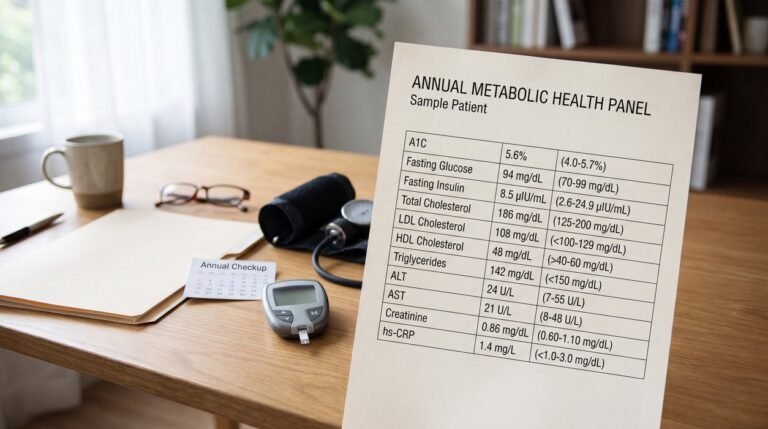
Metabolic Syndrome and Inflammation: Why It’s Not Just About Weight

You notice it first in small ways. The belly fat that will not budge no matter how clean the eating gets. The afternoon energy crash that arrives like clockwork. A lab report that says your numbers are technically okay — but something still feels off.
This pattern is not random. Research increasingly points to a quiet biological process as the common thread behind these symptoms: chronic, low-grade inflammation working hand in hand with disrupted metabolic signaling.
The encouraging news: understanding the link between metabolic syndrome and inflammation opens up practical, evidence-based ways to interrupt the cycle — well before any medication becomes necessary.
Quick Win
One of the fastest ways to lower inflammatory markers like hs-CRP is a 10–15 minute walk after your largest meal of the day. Research suggests this single habit may reduce post-meal glucose spikes by 12–22% — and glucose spikes are a direct driver of the inflammatory signaling this article is about.
In This Article
- What Is the Link Between Metabolic Syndrome and Inflammation?
- The Five Markers Doctors Look For
- Why Belly Fat Acts Like an Active Organ
- Insulin Resistance as the Central Engine
- The Signaling Molecules Behind the Fire
- Obesity, Visceral Fat, and the Vicious Cycle
- Mitochondrial Dysfunction and Chronic Fatigue
- How Stress and Cortisol Make It Worse
- What Can Actually Calm This Internal Fire
- Monitoring and Prevention
- Frequently Asked Questions
What Is the Link Between Metabolic Syndrome and Inflammation?
Metabolic syndrome and inflammation are biologically linked: the same cluster of risk factors that defines the syndrome — central obesity, elevated blood sugar, high blood pressure, altered cholesterol — actively drives a state of chronic, low-grade immune activation inside the body.
Researchers call this “meta-inflammation.” Unlike the redness and swelling that follow an injury, meta-inflammation produces no visible signs. It runs quietly in the background, fueled by dysfunctional fat tissue and disrupted cellular signaling. Over time, this link between metabolic syndrome and inflammation can accelerate cardiovascular disease, type 2 diabetes, and fatty liver.[1]
| Type of Inflammation | Trigger | Duration | What You Notice |
|---|---|---|---|
| Acute | Injury, infection | Days | Pain, heat, swelling |
| Chronic low-grade | Internal imbalance | Months to years | Fatigue, stubborn weight, brain fog |
| Meta-inflammation | Metabolic stress | Continuous | Energy swings, elevated labs |
The Five Markers Doctors Look For
Metabolic syndrome is diagnosed when three out of five specific markers show up together. The 2009 Joint Interim Statement from the International Diabetes Federation, the American Heart Association, and the NHLBI standardized these criteria.
For a more detailed breakdown of each marker, the guide on the 5 criteria for metabolic syndrome walks through what each number means.
| Marker | Threshold (adults, US) |
|---|---|
| Waist circumference | ≥ 35 in (women) / ≥ 40 in (men) |
| Triglycerides | ≥ 150 mg/dL |
| HDL cholesterol | < 50 mg/dL (women) / < 40 mg/dL (men) |
| Blood pressure | ≥ 130/85 mmHg |
| Fasting glucose | ≥ 100 mg/dL |
Three of these five, and the diagnosis is made. Any single marker on its own is not metabolic syndrome — but most people who meet the criteria cross several thresholds at the same time.[7]
Why Belly Fat Acts Like an Active Organ
One of the most important shifts in metabolic research over the past two decades is the recognition that fat tissue is not inert storage. Visceral fat — the kind that accumulates around the liver, pancreas, and intestines — is biologically active.
It secretes dozens of signaling molecules called adipokines. Some are protective. Many, when fat cells become overstressed, are pro-inflammatory.
When visceral fat cells expand beyond their comfortable capacity, they start to malfunction. Immune cells called macrophages infiltrate the tissue. They shift into an inflammatory state and begin producing cytokines that travel through the bloodstream to every organ.[1]
This is why two people with identical BMI can have very different metabolic risk profiles. The amount and distribution of visceral fat matters more than the number on the scale.
| Aspect | Healthy Adipose Tissue | Stressed, Overloaded Tissue |
|---|---|---|
| Primary role | Balanced energy storage, adipokine secretion | Dysregulated signaling, storage overflow |
| Dominant signals | Adiponectin, anti-inflammatory factors | TNF-α, IL-6, leptin resistance |
| Immune activity | Low, resident macrophages at rest | High infiltration, activated macrophages |
| Effect on body | Supports metabolic balance | Drives systemic inflammation |

Insulin Resistance as the Central Engine
If inflammation is the smoke, insulin resistance is the fire underneath. The two reinforce each other in a loop that makes metabolic syndrome so persistent.
Insulin works like a key. Its job is to unlock cells so glucose can enter and be used for energy. In insulin resistance, that key turns less smoothly — cells in muscle, fat, and liver become less responsive to the signal.
The pancreas compensates by producing more insulin. Blood sugar may stay normal for years under this pressure.
Elevated insulin itself may promote fat storage around the midsection and suppress fat oxidation. It also contributes to inflammation in adipose tissue — which in turn worsens insulin resistance.[2]
This is the loop: inflammation impairs insulin signaling, impaired signaling pushes more fat into visceral storage, visceral fat releases more inflammatory cytokines. The cycle can run quietly for a decade before it shows up on a standard lab panel.
HOMA-IR — a simple score calculated from fasting glucose and fasting insulin (not usually included in standard panels, worth requesting specifically) — is one of the earlier signals that this loop has been running.
The Signaling Molecules Behind the Fire
The communication between fat tissue and the rest of the body happens through a class of proteins called cytokines. In metabolic syndrome, several are persistently elevated.
TNF-α and IL-6
TNF-alpha is one of the most studied. It directly interferes with the insulin receptor on muscle and liver cells, reducing their responsiveness to insulin.[2]
IL-6 behaves differently depending on the source. During acute exercise, muscle releases IL-6 briefly with downstream anti-inflammatory effects. Chronically elevated IL-6 from stressed fat tissue promotes insulin resistance instead.
hs-CRP (high-sensitivity C-reactive protein) is produced by the liver in response to IL-6. Values above 3 mg/L suggest significant low-grade inflammation and independently predict cardiovascular risk. Most standard lab panels do not include hs-CRP — it usually needs to be requested specifically.
Adipokines That Matter
Adiponectin is one of the few protective signals from fat tissue. It improves insulin sensitivity and has anti-inflammatory effects. Adiponectin levels drop as visceral fat grows — one of the few times where less is worse.
Leptin tells the brain about fat stores and energy availability. In metabolic syndrome, leptin is usually high but the brain stops listening properly. This leptin resistance makes appetite regulation harder and fuels further weight gain.
Obesity, Visceral Fat, and the Vicious Cycle
Carrying extra weight — especially around the midsection — places persistent stress on adipose tissue. The fat cells stretch. Oxygen supply to the core of the tissue drops. Some cells undergo a stressed form of cell death.
Macrophages move in to clean up the damage. But instead of finishing the job and leaving, they stay. They activate. They release inflammatory cytokines continuously — which is exactly what the tissue around them does not need.[1]
This is why obesity is so tightly coupled with every downstream feature of metabolic syndrome. Not because weight itself is the problem — but because dysfunctional visceral fat is.
You are not alone in this cycle. Meta-inflammation can develop quietly over a decade or more — which is why so many people feel caught off guard when their doctor first mentions it. It is biology, not a personal failure. And the research is clear that it responds to consistent, specific inputs over time.
Most guides skip this, but it matters: losing weight is not automatically the same as reducing visceral inflammation. Someone who drops 15 pounds through extreme calorie restriction while sleeping 5 hours a night and running on stress may see their weight fall while their hs-CRP barely moves.
The body does not respond to the number on the scale — it responds to the specific signals it gets from fat tissue, sleep, movement, and food quality. Research points to moderate, sustained lifestyle shifts that improve visceral fat specifically — rather than aggressive weight loss — as the stronger predictor of lower inflammatory markers.[3]
This reframe is worth sitting with. It explains why some people lose weight and still feel inflamed — and why others see dramatic improvements in labs without much weight change at all.

Mitochondrial Dysfunction and Chronic Fatigue
The fatigue that so often accompanies metabolic syndrome has a biological address: the mitochondria — the tiny structures inside every cell that produce the energy the body runs on.
When cells are bathed in chronic inflammation and high insulin, mitochondrial function suffers. They become less efficient at burning fat for fuel. They produce more reactive oxygen species — internal exhaust that damages proteins and DNA. Energy output drops.
This is why afternoon crashes and unexplained fatigue are so common with this syndrome. It is not laziness or aging alone. It is a cellular energy problem with a specific underlying cause.
The loop here is self-reinforcing too. Low energy makes movement feel harder. Less movement means less mitochondrial stimulus to regenerate. The cells stay stuck in low-output mode.
How Stress and Cortisol Make It Worse
Cortisol is the hormone that rises in response to stress. In short bursts, it is useful. Chronically elevated, it becomes a problem.
High cortisol tells the body to store fat specifically in the abdomen. It raises blood sugar by prompting the liver to release glucose. It blunts insulin sensitivity.
Sleep restriction is one of the fastest ways to elevate cortisol. Just one week of five hours of sleep per night may reduce glucose tolerance by 30–40% in healthy adults — an effect size similar to early type 2 diabetes.[5]
This is why stress and sleep are not side notes in a metabolic syndrome plan. They are central levers.
What Can Actually Calm This Internal Fire
The research on reducing inflammation in metabolic syndrome is more encouraging than most people expect. The interventions are not complicated. They are specific.
1. Move after meals
A 10–15 minute walk after the largest meal of the day is one of the most studied and effective interventions. Research suggests post-meal walking reduces postprandial glucose spikes more than a single longer walk at another time of day.[4]
Glucose spikes are direct drivers of inflammation. Blunting them consistently lowers the baseline inflammatory signal over weeks.
2. Build meals around the Mediterranean pattern
The PREDIMED trial — one of the largest dietary intervention studies ever conducted — found that a Mediterranean diet rich in olive oil, nuts, legumes, fish, and vegetables led to metabolic syndrome remission in up to 14% of participants. It outperformed a low-fat control diet substantially.[3]
The mechanism is partly about what the diet adds — polyphenols, omega-3s, fiber — and partly about what it displaces: ultra-processed foods, added sugars, and industrial seed oils.
3. Prioritize 7+ hours of sleep
Sleep is often the missing piece. Sleeping less than 7 hours consistently raises cortisol, impairs glucose tolerance, and drives up inflammatory markers.
This is not a “nice to have.” For anyone working on metabolic health, adequate sleep often moves the needle faster than any dietary change.
4. Add resistance training 2–3 times per week
Skeletal muscle is responsible for roughly 80% of insulin-mediated glucose uptake.[6] Growing or maintaining it directly improves insulin sensitivity. Resistance training two to three times per week may improve insulin sensitivity independent of weight loss — often within 6–8 weeks.
What to expect, and when
Timelines matter because they set realistic expectations.
| Timeframe | What Often Changes |
|---|---|
| 1–2 weeks | Post-meal energy steadier, afternoon crashes less severe, sleep quality improves |
| 4–6 weeks | Fasting glucose may begin to drop, waist measurement often starts shifting, hs-CRP trending down |
| 8–12 weeks | Meaningful improvements in triglycerides, HDL, HOMA-IR; measurable drop in inflammatory markers |
| 6 months | Full picture of which markers respond most to your specific pattern; retest panel useful |
Many people notice the energy shift first. The labs follow.
Monitoring and Prevention
Standard annual physicals do not always catch metabolic syndrome early. Fasting glucose stays normal for years while insulin is climbing. hs-CRP is not routinely ordered.
A more useful panel to request includes: fasting insulin, HOMA-IR, hs-CRP, triglyceride-to-HDL ratio, HbA1c, and waist circumference. Some clinicians also use the Lipid Accumulation Product (LAP) or Visceral Adiposity Index (VAI) — calculations based on waist size and blood markers that can flag metabolic risk earlier than BMI alone.
For a broader view of how this syndrome develops, the guide on why metabolic syndrome has nothing to do with willpower offers more context on the weight-inflammation confusion.
Conclusion
The story behind metabolic syndrome is not really about the number on a scale. It is about a quiet, persistent conversation between fat tissue, the immune system, and the cells that respond to insulin.
When that conversation goes well, energy stays steady and labs stay clean. When it goes poorly, inflammation fuels insulin resistance and insulin resistance fuels more inflammation — a loop that builds slowly and costs a lot.
The most useful response is not dramatic. It is specific: walk after meals, build meals from real food, protect your sleep, move weight against resistance a few times a week, and check the right markers.
Small choices, repeated over weeks, rewrite the signaling. Your body is not fighting you here. It is responding — and responsive biology is exactly the kind that can shift.
Frequently Asked Questions
What is the main link between metabolic syndrome and inflammation?
The main link is visceral fat — the kind stored around internal organs. When this fat tissue expands beyond a healthy capacity, its cells become stressed and recruit immune cells called macrophages. These activated macrophages release inflammatory cytokines like TNF-α and IL-6, which circulate throughout the body. The chronic presence of these signals directly impairs insulin action, which is why metabolic syndrome and inflammation travel together so reliably. Breaking the cycle at either point — reducing visceral fat or calming inflammatory signaling — tends to improve the other.
How does insulin resistance start, and why does it make everything worse?
Insulin resistance usually starts quietly in muscle and liver tissue. When cells are constantly exposed to high levels of glucose and free fatty acids — and to persistent inflammatory signals from visceral fat — they gradually become less responsive to insulin. The pancreas compensates by producing more. Elevated insulin itself promotes visceral fat storage and suppresses fat burning, which worsens the inflammation driving the resistance in the first place. This self-reinforcing loop is why blood sugar may stay normal for years while the underlying dysfunction progresses.
Can you have metabolic syndrome at a normal weight?
Yes. The condition is sometimes called “TOFI” — thin outside, fat inside — when someone has a normal BMI but significant visceral fat. Waist circumference often reveals what BMI misses. Someone at a healthy weight with a waist over the 35-inch (women) or 40-inch (men) threshold, combined with elevated triglycerides, low HDL, or rising blood pressure, can still meet metabolic syndrome criteria. This is why labs and measurements matter more than the scale alone.
What are the most practical ways to lower this type of inflammation?
Daily habits matter more than any single intervention. A Mediterranean-style eating pattern — rich in olive oil, fatty fish, legumes, nuts, vegetables, and fruit — is one of the most robustly studied approaches for lowering inflammatory markers. Regular movement, especially short walks after meals, reduces post-meal glucose spikes that drive inflammation. Seven or more hours of sleep and 2–3 weekly resistance training sessions round out the foundation. Most people see hs-CRP and fasting insulin begin to shift within 8–12 weeks of consistent practice.
Which blood tests show low-grade inflammation?
High-sensitivity C-reactive protein (hs-CRP) is the most commonly ordered marker, but it usually has to be requested specifically — it is not part of a standard lab panel. Values above 3 mg/L suggest significant low-grade inflammation and predict cardiovascular risk independently of cholesterol. Fasting insulin and HOMA-IR reveal the insulin resistance that accompanies chronic inflammation. For more targeted assessment, some clinicians order IL-6 or ferritin (which rises with inflammation). The Lipid Accumulation Product and Visceral Adiposity Index use waist measurement and lipid numbers to estimate metabolic risk more precisely than BMI alone.
Medical Disclaimer: The information provided in this article is for educational purposes only and does not constitute medical advice. Always consult a qualified healthcare provider before making changes to your diet, lifestyle, or treatment plan. TheMetabolicHub.com does not replace professional medical guidance.
References
- Ouchi N, Parker JL, Lugus JJ, Walsh K. Adipokines in inflammation and metabolic disease. Nat Rev Immunol. 2011;11(2):85–97. PMID: 21219177
- Hotamisligil GS. Inflammation and metabolic disorders. Nature. 2006;444(7121):860–867. PMID: 17167474
- Estruch R, Ros E, Salas-Salvadó J, et al. Primary prevention of cardiovascular disease with a Mediterranean diet supplemented with extra-virgin olive oil or nuts (PREDIMED). N Engl J Med. 2018;378(25):e34. PMID: 29897866
- Buffey AJ, Herring MP, Langley CK, Donnelly AE, Carson BP. The acute effects of interrupting prolonged sitting with short bouts of activity on postprandial glycemic response. Sports Med. 2022;52(8):1765–1787. PMID: 35115009
- Spiegel K, Knutson K, Leproult R, Tasali E, Van Cauter E. Sleep loss: a novel risk factor for insulin resistance and Type 2 diabetes. J Appl Physiol. 2005;99(5):2008–2019. PMID: 16227462
- DeFronzo RA, Tripathy D. Skeletal muscle insulin resistance is the primary defect in type 2 diabetes. Diabetes Care. 2009;32(Suppl 2):S157–S163. PMID: 19875544
- National Heart, Lung, and Blood Institute. Metabolic Syndrome — Causes and Risk Factors. nhlbi.nih.gov
- American Heart Association. About Metabolic Syndrome. heart.org