
Are You Eating Enough Protein—but at the Wrong Times?

You finish dinner feeling uncomfortably full, then remember that breakfast was toast and lunch was mostly salad. Your daily protein total may look respectable on paper while most of it arrives in one evening meal.
Protein distribution throughout the day may matter for how often meals stimulate muscle protein synthesis, especially during aging or resistance training. Still, total daily protein, adequate energy, protein quality, and exercise are more important than achieving a perfect clock-based schedule.
Quick Win: Review yesterday’s meals and identify the lightest protein meal. Add one familiar protein food there before changing your whole day.
Does Protein Distribution Throughout the Day Matter?
It can, but timing is not a magic switch. Eating meaningful protein at several meals gives muscle repeated opportunities to use amino acids for repair and remodeling, while concentrating nearly everything at dinner leaves earlier meals with a smaller stimulus.
A small controlled crossover study found higher 24-hour muscle protein synthesis when adults ate roughly similar protein amounts at breakfast, lunch, and dinner instead of a strongly dinner-heavy pattern.[1] That finding is interesting, not a universal prescription.
Longer and newer trials have not consistently shown that even distribution improves muscle mass, strength, function, or muscle protein synthesis when total intake is matched.[2], [3] A practical conclusion is to fix obvious gaps without treating every meal like a laboratory dose.
What the Research Shows—and What It Does Not
Protein supplies amino acids used throughout the body, including in skeletal muscle. A meal containing protein raises circulating amino acids and can stimulate muscle protein synthesis, but the response depends on age, body size, activity, health, protein quality, and the meal itself.
The evidence for a more even pattern
In the frequently cited Mamerow trial, eight healthy adults completed two controlled seven-day eating patterns with the same daily protein. The evenly distributed pattern produced a higher 24-hour muscle protein synthesis rate than the sharply dinner-skewed pattern.[1]
The design controlled meals carefully, which strengthens the comparison. However, eight participants and a short intervention cannot tell us whether the pattern preserves more muscle or improves strength over months or years.
Why the evidence remains mixed
An eight-week randomized trial in older adults found no significant difference in lean body mass, strength, function, or protein kinetics between even and uneven patterns.[2] The study was also small, so it does not settle the question.
Another randomized study in adults aged 65–80 found no difference in daily muscle protein synthesis or dietary protein use after even versus skewed meal distribution.[3] Reviews therefore describe distribution as plausible and potentially useful, while acknowledging inconsistent longer-term outcomes.[4]
| Priority | Why it matters | Practical question |
|---|---|---|
| Total daily intake | A balanced schedule cannot compensate for chronically inadequate intake | Are you regularly meeting a suitable daily amount? |
| Meal distribution | Several protein-containing meals may provide repeated muscle-building opportunities | Is one meal doing nearly all the work? |
| Protein quality and variety | Different foods contribute different amino acids and nutrients | Are your choices varied and satisfying? |
| Resistance exercise | Training provides a strong reason for muscle to adapt | Does your week include progressive muscle work? |
Most guides skip this, but it matters: “even” does not have to mean mathematically identical meals. The evidence does not justify anxiety over a five-gram difference or a missed snack; the useful target is avoiding a repeated pattern of protein-poor meals followed by an oversized dinner.
How to Spot a Dinner-Heavy Protein Pattern
You do not need an app to begin. Write down your main meals from two ordinary weekdays and one weekend day, then circle the foods that contribute meaningful protein.
A pattern may be skewed when breakfast is mostly refined carbohydrate, lunch is vegetables with little protein, and dinner contains a large serving of meat, fish, tofu, or legumes. Snacks can contribute, but they do not need to become mandatory mini-meals.
Check breakfast first
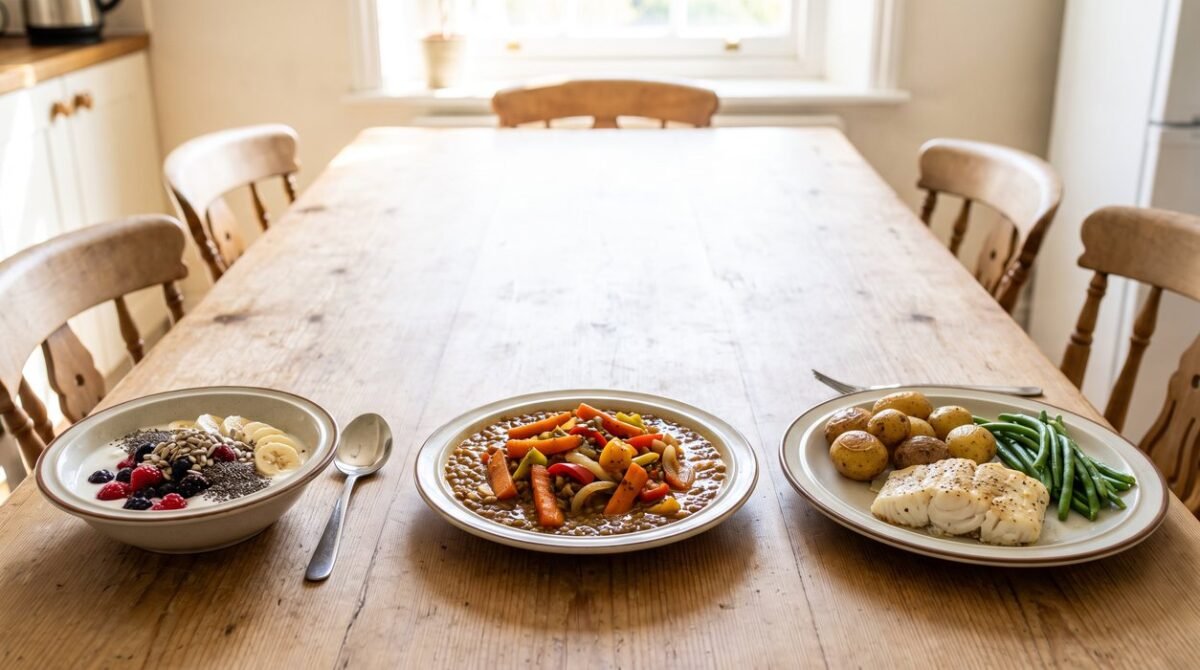
Breakfast is often the easiest place to find a gap. Toast, fruit, cereal, or coffee can fit into a balanced day, but each may need a protein partner if breakfast otherwise contains very little.
Options include Greek-style yogurt, cottage cheese, eggs, fortified soy yogurt, tofu, beans, milk, soy milk, or leftovers that suit your preferences. The best choice is one you tolerate, enjoy, and can repeat.
Look at lunch structure
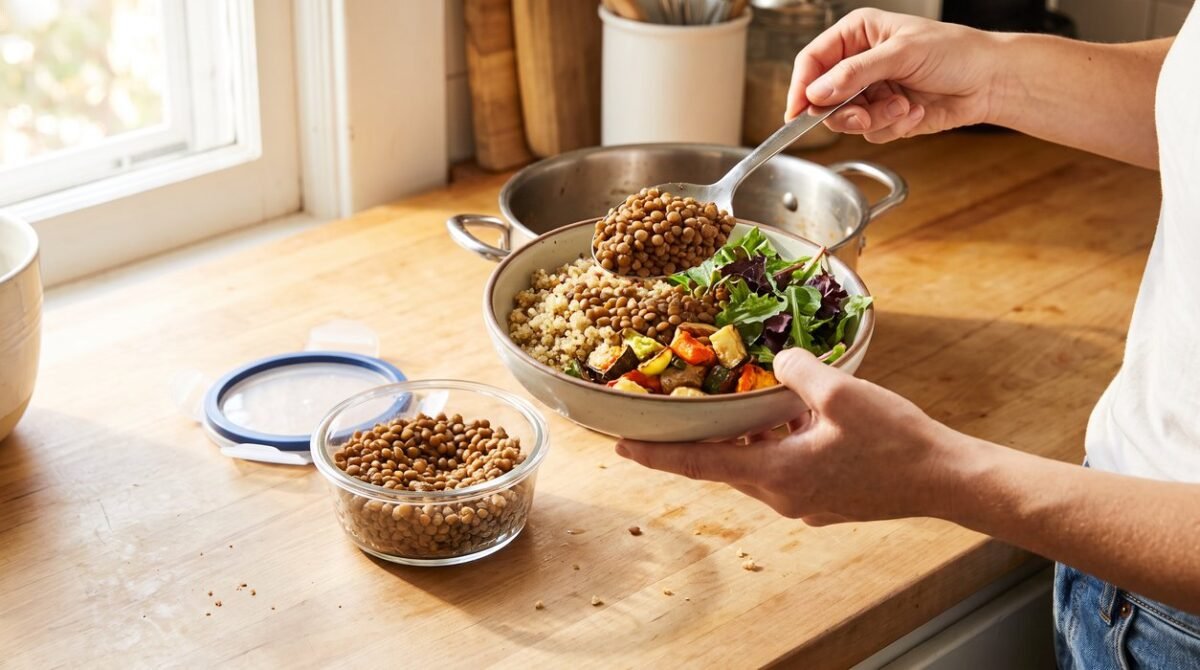
A vegetable-rich lunch is valuable, yet a few seeds or a thin swipe of hummus may not make it a substantial protein meal. Add a clear protein component such as lentils, beans, tofu, tempeh, fish, poultry, eggs, dairy, or a suitable alternative.
If you are unsure about your overall needs, start with the broader guide to protein for women’s metabolic health. It covers daily intake, activity, aging, and food sources without turning one number into a rule for everyone.
How to Build Better Distribution Without Meal-Prep Perfection
The goal is not to add protein on top of an already adequate diet until every meal becomes larger. Often, distribution means moving part of a dinner portion earlier or replacing a low-protein item with a more useful option.
- Anchor three eating occasions. Choose breakfast, lunch, and dinner—or three meals that match your schedule—and include an identifiable protein food at each.
- Strengthen the weakest meal first. Add yogurt to breakfast, lentils to soup, tofu to a grain bowl, tuna to a sandwich, or beans to a prepared salad.
- Reduce the dinner pile if needed. When dinner carries most of the day’s protein, move some of that food to lunch rather than increasing the entire day.
- Use convenience deliberately. Frozen edamame, canned beans, plain yogurt, cooked eggs, tinned fish, tempeh, and lower-sodium prepared proteins can make consistency easier.
- Pair the plan with strength training. Protein timing cannot replace the training stimulus that tells muscle to adapt.
A realistic two-week experiment: Add a clear protein source to your lightest meal and keep dinner comfortable rather than oversized. Notice hunger, meal satisfaction, training recovery, digestion, and how easy the pattern is to maintain.
These observations can help with routine design, but they do not prove a change in muscle mass or metabolism. Strength progress, dietary adequacy, and clinically relevant measurements require a longer view.
When Protein Timing Deserves More Attention
Distribution may be especially useful to discuss during healthy aging, resistance training, recovery from illness or surgery, reduced appetite, or intentional weight loss. These situations can increase the importance of preserving muscle or make it harder to eat enough overall.
If low intake is the concern, the article on signs you may not be eating enough protein can help you prepare questions. Symptoms are nonspecific, so a dietitian or clinician should assess persistent weakness, unintended weight loss, or poor intake.
Kidney disease and medically restricted diets
People with chronic kidney disease may receive individualized protein targets based on disease stage, dialysis, nutrition status, and other factors. Do not increase protein or copy a fitness-oriented schedule without guidance from your renal clinician or dietitian.
Pregnancy, breastfeeding, and eating-disorder recovery
Needs and meal structure can differ during pregnancy, breastfeeding, and recovery from disordered eating. In these settings, adequacy and a safe relationship with food take priority over hitting rigid per-meal targets.
Plant-based eating
Plant-based meals can provide substantial protein, but portions and food combinations deserve attention. Soy foods, legumes, lentils, peas, seitan, nuts, seeds, and higher-protein grains can be spread across meals without requiring protein powder.
Frequently Asked Questions
What is the best protein distribution throughout the day?
There is no universally proven split for every adult. A practical pattern places a meaningful protein source at several meals, avoids relying almost entirely on dinner, and still prioritizes an appropriate total intake.
Do I need 30 grams of protein at every meal?
No single number fits every body size, age, activity level, health condition, and meal pattern. Some acute studies used about 30 grams per meal, but that does not establish a required dose for everyone.[1]
Is breakfast protein more important than dinner protein?
Breakfast is often lower in protein, so improving it can make the day less skewed. Dinner is not a problem; the issue is whether earlier meals regularly contribute very little.
Do I need a protein snack before bed?
Not routinely. A bedtime snack may suit some athletes or people with higher needs, but it can be unnecessary if your daily intake and meals are already adequate.
Conclusion
Protein timing is a refinement, not the foundation. Meet an appropriate daily intake, eat enough overall, choose varied protein foods, and include resistance exercise before worrying about perfect meal symmetry.
If breakfast and lunch are consistently protein-light, strengthen one of them for two weeks and see whether the pattern feels more satisfying and sustainable. The best schedule is the one that supports your health without turning normal eating into constant arithmetic.
Medical Disclaimer: This article is for educational purposes only and is not a substitute for individualized medical advice, diagnosis, or treatment. Speak with a qualified healthcare professional if you have a medical condition, take medication, are pregnant, or have persistent or concerning symptoms. Seek urgent medical care for severe or rapidly worsening symptoms.
References
- Mamerow MM et al. Dietary Protein Distribution Positively Influences 24-h Muscle Protein Synthesis in Healthy Adults. The Journal of Nutrition. 2014. Full text at PubMed Central
- Kim IY et al. Protein intake distribution pattern does not affect anabolic response, lean body mass, muscle strength or function over 8 weeks in older adults: A randomized-controlled trial. Clinical Nutrition. Full text at PubMed Central
- Højfeldt G et al. Comparing Even with Skewed Dietary Protein Distribution Shows No Difference in Muscle Protein Synthesis or Amino Acid Utilization in Healthy Older Individuals: A Randomized Controlled Trial. International Journal of Sport Nutrition and Exercise Metabolism. 2022. Full text at PubMed Central
- Hudson JL et al. Impacts of protein quantity and distribution on body composition. Frontiers in Nutrition. 2024. Full text at PubMed Central