Blood Sugar Stabilizing Snacks: Simple Formulas That Actually Work

That 3pm pull toward the pantry — slightly lightheaded, a little foggy, suddenly unable to focus — isn’t a willpower problem. It’s a blood sugar signal.
For many women in their 30s, 40s, and 50s, that signal has been getting louder. The encouraging news: the fix isn’t about eating less. It’s about eating smarter combinations.
Estrogen and progesterone directly influence how well cells respond to insulin — meaning the same snack that worked a decade ago may now leave you crashing by mid-afternoon.
This is not a personal failure. It’s biology. And it responds well to the right approach.[3]
What Are Blood Sugar Stabilizing Snacks?
Blood sugar stabilizing snacks are food combinations built around at least two of three nutritional anchors — protein, fat, or fiber — that slow glucose absorption and prevent the rapid spikes and crashes that drive energy dips, cravings, and brain fog.
Choosing the right snack is partly about preventing a drop between meals — but it’s also about avoiding a sharp rise. If you want to understand what a significant glucose spike looks like and how the body responds to it, the guide to post-meal blood sugar spikes explains the full picture.
Research suggests that pairing carbohydrates with protein, fat, or fiber meaningfully reduces the blood sugar response after eating.[1]
Key Takeaways
- Blood sugar crashes between meals are often caused by snack combinations — not hunger itself.
- Every stabilizing snack needs at least two anchors: protein, fat, or fiber.
- Timing your snacks matters almost as much as what you eat.
- Many “healthy” snacks — rice cakes, fruit juice, low-fat yogurt — may spike blood sugar nearly as fast as candy.
- Formula-based snacking requires no calorie counting. Just pattern recognition.
Why Most Snacks Make Things Worse
The problem with typical snacking isn’t eating between meals — it’s eating carbohydrates alone.
A rice cake, a handful of crackers, or even a plain banana sends glucose into the bloodstream quickly. The pancreas responds with insulin. Blood sugar drops. You feel worse than before you ate.
This cycle is especially common with snacks marketed as “healthy” or “light.” Low-fat yogurt with fruit syrup, granola bars, flavored rice cakes — these are essentially sugar delivery vehicles with good branding.
| Snack | Why It Spikes Blood Sugar |
|---|---|
| Rice cakes + jam | High glycemic, virtually no protein or fat to slow absorption |
| Fruit juice or smoothies (no protein) | Liquid sugar hits bloodstream fast — no fiber buffer |
| Low-fat flavored yogurt | Often 20–25g sugar per serving; fat removal speeds absorption |
| Granola or “protein” bars (>15g sugar) | Marketing obscures high sugar content |
| Dried fruit alone | Concentrated sugar without the fiber buffer of whole fruit |
The 3-Anchor Formula
Stable blood sugar comes from slowing glucose absorption. Three nutrients do this effectively: protein, fat, and fiber.
You don’t need all three in every snack — but you need at least two to build a meaningful buffer against a glucose spike.[1]
Think of it as building a speed bump for sugar absorption. When carbohydrates are present — and they don’t have to be — pairing them with two anchors meaningfully flattens the glucose response.
The formula: Protein + Fat · or · Protein + Fiber · or · Fat + Fiber · or · all three.
Ready-to-Use Snack Combinations
Below are practical combinations built on the 3-anchor formula. Each one takes under two minutes to assemble and uses ingredients easy to keep on hand.
| Snack | Anchors | Why It Works |
|---|---|---|
| Hard-boiled egg + handful of walnuts | Protein + fat | Virtually zero glucose impact. Keeps hunger away for 2–3 hours. |
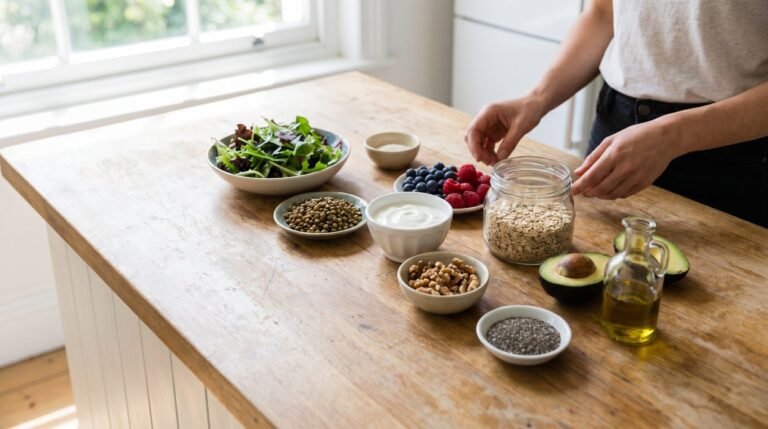
| Plain Greek yogurt + chia seeds + berries | Protein + fat + fiber | All three anchors. Chia adds fiber and fat; berries provide low-glycemic carbs and antioxidants.[5] |
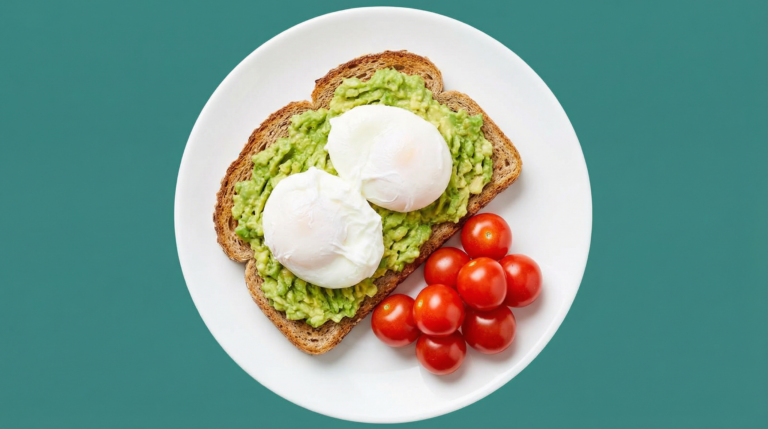
| Avocado on seed crackers | Fat + fiber | Choose crackers with >3g fiber per serving. Genuinely satisfying. |
| Cottage cheese + cucumber slices | Protein + fiber | Light but effective. Add a drizzle of olive oil for a fat anchor. |
| Almond butter + celery sticks | Fat + fiber | Celery fiber slows absorption; almond butter adds lasting satiety. |
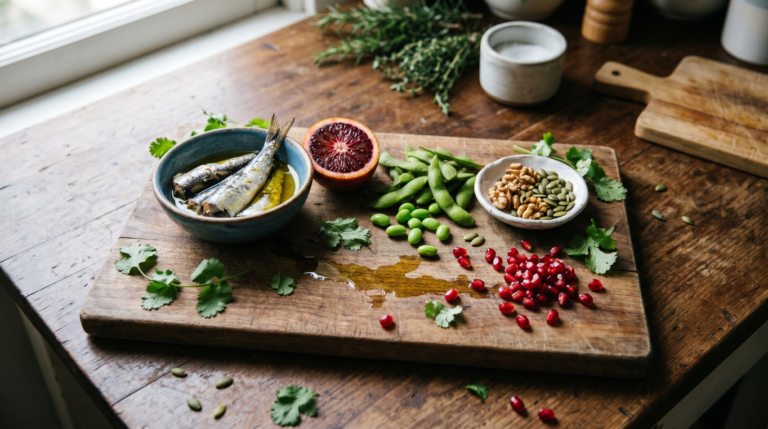
| Sardines or tuna + cucumber | Protein + fiber | Omega-3s may also support insulin sensitivity over time.[2] |
| Hummus + carrot and pepper sticks | Protein + fat + fiber | All three anchors. Easy to prep in advance and portable. |
| Apple slices + almond butter | Fiber + fat | Apple fiber slows glucose; fat extends satiety beyond the fruit alone. |
Snack Comparison: Spike vs. Stable
| Snack | Anchors Present | Blood Sugar Effect | Verdict |
|---|---|---|---|
| Rice cake + jam | None | Rapid spike → crash | Avoid |
| Banana alone | Minimal fiber | Moderate spike likely | Limit |
| Low-fat fruit yogurt | Some protein | Spike from added sugar | Avoid |
| Apple + almond butter | Fiber + fat | Gentle, sustained rise | Good |
| Greek yogurt + chia + berries | Protein + fat + fiber | Flat, stable response | Excellent |
| Egg + walnuts | Protein + fat | Minimal glucose impact | Excellent |
| Hummus + veggie sticks | Protein + fat + fiber | Flat, stable response | Excellent |
When You Snack Matters Too
Timing isn’t everything — but it’s more relevant than most people realize.
Snacking randomly throughout the day keeps insulin levels persistently elevated, which over time may blunt insulin sensitivity.[4]
The goal is to snack strategically: to bridge a genuine gap between meals, not to graze continuously.
| Timing Window | Situation | Best Anchor Combo |
|---|---|---|
| Mid-morning | Breakfast was small or early | Protein + fat — reach lunch without a crash |
| Mid-afternoon (2–4pm) | Highest-risk energy dip window | All three anchors if possible — this is when crashes hit hardest |
| Evening | Long gap before bed | Light protein + fat — won’t disrupt overnight blood sugar |
Building a Simple Snack Routine That Sticks
The most effective snack strategy isn’t complicated — it’s consistent.
Start by removing the high-spike options from your immediate environment. Then stock two or three combinations you actually enjoy. Variety matters less than reliability.
A practical starting point: keep hard-boiled eggs in the fridge, a jar of almond or peanut butter in the cupboard, and a bag of mixed seeds on the counter.
With those three items, you can build a stabilizing snack in under two minutes, any time of day.
Over weeks, many people notice crashes becoming less frequent, the afternoon fog lifting earlier, and the urgent need to snack becoming more manageable.
That’s not coincidence — it’s blood sugar responding to consistent, intentional fueling.[6]
Conclusion
Snacking doesn’t have to be complicated — and it doesn’t have to work against you.
The 3-anchor formula gives you a clear, repeatable framework: pair any snack with at least two of protein, fat, or fiber, and let the combinations do the work.
Small shifts in what you reach for between meals can produce real, noticeable changes in how you feel throughout the day. You’ve been paying attention to your body. Now you have a clearer map for responding to what it’s telling you.
Frequently Asked Questions
What are the best blood sugar stabilizing snacks?
The best blood sugar stabilizing snacks are combinations that include at least two of three anchors: protein, fat, or fiber. Research suggests these nutrients slow glucose absorption and may help reduce post-meal blood sugar spikes. Practical options include plain Greek yogurt with chia seeds and berries, hard-boiled eggs with walnuts, almond butter with celery or apple slices, and hummus with vegetable sticks. The key is the combination — not any single ingredient.
How often should I snack to keep blood sugar stable?
For most people, snacking 1–2 times per day — in genuine gaps between meals — may support more stable blood sugar than continuous grazing. Evidence suggests that frequent, unstructured snacking can keep insulin levels persistently elevated, which over time may reduce insulin sensitivity. The goal is intentional snacking to bridge real hunger gaps, not habitual eating out of boredom or stress. A doctor or registered dietitian can help you identify the right pattern for your specific needs.
Can fruit be part of a blood sugar stabilizing snack?
Yes — but pairing matters. Whole fruit eaten alone may produce a moderate blood sugar rise, depending on the fruit and your individual response. Lower-glycemic options like berries, green apple, and pear tend to produce gentler responses than tropical fruits or dried fruit. Pairing any fruit with a protein or fat source — almond butter, a handful of nuts, plain Greek yogurt — may help slow glucose absorption and reduce the spike. Fruit juice, even 100% juice, removes the fiber buffer and is best limited.
Are store-bought protein bars good for blood sugar?
Most commercial protein bars contain 15–25g of sugar or sugar alcohols, which can still trigger meaningful blood sugar responses despite the protein content. Some bars with lower sugar (<5g), higher fiber (>3g), and minimal additives may be a reasonable occasional option — but reading the label matters. A simpler alternative is building a real-food snack from the 3-anchor formula, which typically offers more nutritional transparency and less processing. If you rely on bars for convenience, check that protein is at least 10g and sugar is under 8g per serving.
Medical Disclaimer: The information provided in this article is for educational purposes only and does not constitute medical advice. Always consult a qualified healthcare provider before making changes to your diet, lifestyle, or treatment plan. TheMetabolicHub.com does not replace professional medical guidance.
References
- Gentilcore D, et al. Slow gastric emptying with protein: effects on postprandial glycemia. Diabetes Care. 2010.
PMID: 19631004 - Storlien LH, et al. Fish oil prevents insulin resistance induced by high-fat feeding. Science. 1987.
PMID: 3616557 - Mauvais-Jarvis F, et al. The role of estrogens in control of energy balance and glucose homeostasis. Endocr Rev. 2013.
PMID: 23460719 - Kahleova H, et al. Meal frequency and timing in health and disease. Proc Nutr Soc. 2020.
PMID: 22473579 - Vuksan V, et al. Supplementation of conventional therapy with chia seeds improves glycemic control. Diabetes Care. 2007.
PMID: 17327330 - Pot GK, et al. Meal irregularity and metabolic consequences. Br J Nutr. 2016.
PMID: 28179869