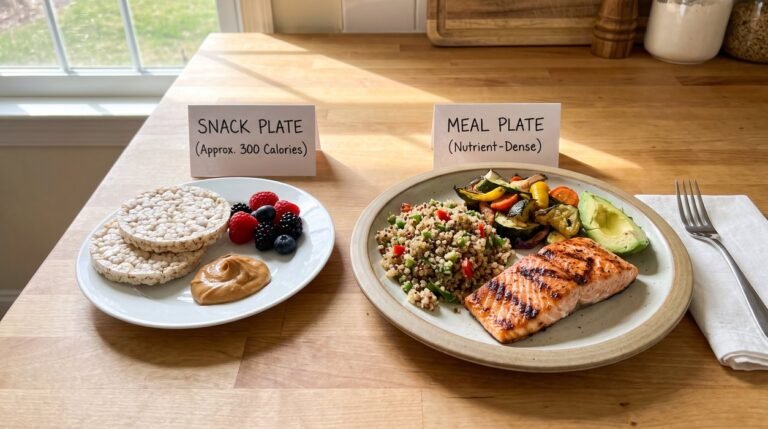
Why Weekend Eating Can Erase a Weekday Calorie Deficit

You can eat carefully from Monday through Friday, step on the scale after the weekend, and wonder how several solid days disappeared. The frustrating part is that nothing may have felt extreme: brunch, a restaurant dinner, a few drinks, and less movement than usual.
Weekend overeating and weight loss can clash when those small changes repeat across Saturday and Sunday. One meal does not erase progress, but a recurring rise in energy intake can reduce or fully offset the calorie deficit created during the week.
Key Takeaway: Think in seven-day patterns, not perfect days. Keep one or two weekend meals flexible while giving the rest of the weekend enough structure to protect your weekly average.
How Weekend Overeating and Weight Loss Affect the Weekly Deficit
Fat loss requires an energy deficit over time: on average, the body uses more energy than it receives. The body does not restart that accounting at midnight, so the weekly pattern matters more than whether every individual day looks identical.
Consider an illustrative example, not a personal calorie prescription. A 400-calorie deficit on five weekdays adds up to 2,000 calories, while eating 1,000 calories above maintenance on both weekend days would offset that entire weekly gap.
| Pattern | Illustrative balance | Weekly result |
|---|---|---|
| Weekdays | 5 × −400 calories | −2,000 calories |
| Weekend | 2 × +1,000 calories | +2,000 calories |
| Seven-day total | −2,000 + 2,000 | Approximately maintenance |
Real bodies are more dynamic than simple arithmetic, and calorie estimates are imperfect. Still, the example shows why genuine weekday effort can coexist with little average weight change.
Your energy needs also change with body size, activity, and time, so a static “calories in versus calories out” slogan is not a personal calculator. The NIDDK Body Weight Planner uses a dynamic model to illustrate how intake and activity changes may alter a projected weight path.[4]
Use that kind of tool for perspective, not precision. Restaurant portions, tracking error, menstrual-cycle changes, medication, sleep, and spontaneous movement can all make your real result differ from a projection.
In a small year-long trial, participants tended to eat more on Saturdays and move less on Sundays. Weight loss slowed or stopped over weekends even while weekday energy balance remained negative.[1]

Why Weekends Are Easy to Underestimate
The weekend changes the environment. Meal times move, portions are served by restaurants, alcohol or sweetened drinks appear, and ordinary movement from commuting or errands may fall away.
No single item has to be enormous. Restaurant oil, shared starters, a second drink, bites while cooking, and a late snack can accumulate without producing the memory of a binge.
Liquid calories and social grazing are easy to miss
Drinks often arrive outside the mental boundary of a meal. Grazing creates the same problem because several small tastes rarely feel like a complete eating occasion, even though they still contribute energy.
Self-reported food intake is generally less accurate than objective energy-expenditure methods, and underreporting is common across many groups.[3] That is a measurement problem, not a character flaw.
Activity can drop at the same time
A relaxed weekend may include more sitting, driving, streaming, or socializing. The food change receives most of the attention, but lower daily movement can narrow the deficit from the other side.
This is not a reason to “earn” food with exercise. It is a reason to notice when the weekend removes movement that happened automatically during the workweek.
One thing worth pushing back on here: the problem is not that weekends must look like weekdays. The useful distinction is between planned flexibility and an unobserved two-day pattern that repeatedly works against your stated goal.
Why the Scale May Jump on Monday
A higher Monday weight does not tell you how much body fat changed. Restaurant meals often contain more sodium and carbohydrate, both of which can increase stored water, while later meals add more digestive contents at weigh-in.
Menstrual-cycle timing, constipation, travel, and alcohol-related sleep disruption can add further noise. Compare trends under similar conditions instead of treating one measurement as a verdict.
If scale changes feel consuming or trigger compensatory restriction, weighing less often—or not weighing—may be the safer choice. You can use waist measurements, clothing fit, routine consistency, strength, or clinician-monitored markers instead.
How to Protect Progress Without Rigid Weekend Rules
1. Keep two anchor meals
Choose two meals each day that resemble your normal structure: a protein source, a fiber-rich food, and a satisfying carbohydrate or fat. Anchors reduce the chance that every meal becomes an open-ended event.
2. Decide where flexibility matters most
If dinner with friends matters, keep breakfast and lunch ordinary instead of “saving calories” by arriving ravenous. Extreme compensation often makes the flexible meal harder to navigate.
3. Make extras visible
You do not need permanent calorie tracking. For one or two weekends, note drinks, cooking tastes, sauces, starters, and late snacks to identify which extras actually change the weekly picture.
Digital self-monitoring can support weight loss for some adults, but accuracy is limited and the tool should remain emotionally neutral.[3] Stop if tracking increases anxiety, guilt, or disordered eating.
4. Preserve ordinary movement
Keep one familiar movement cue: a walk after brunch, errands on foot, a planned class, gardening, or active time with family. The aim is continuity, not punishment.
5. Return to normal at the next meal
Do not follow a richer meal with fasting, detoxes, or an exhausting workout. Resume your normal eating pattern at the next reasonable opportunity and let the weekly average recover without drama.
6. Adjust the weekly plan, not just the weekend
If your weekday deficit leaves you intensely hungry by Friday, the plan may be too aggressive. A smaller weekday deficit with more satisfying meals can be easier to carry through the full week than five highly restrictive days followed by two rebound days.
Medication, perimenopause, PCOS, sleep apnea, thyroid disease, and other factors may also affect appetite or weight. Persistent unexplained changes deserve a healthcare conversation rather than repeated attempts to tighten the rules.
If hidden extras are a recurring issue, the guide to hidden calories in everyday meals can help you identify high-impact changes without labeling foods as bad.

A Realistic Two-Day Weekend Plan
- Friday: Name the social meal or treat you most want to enjoy.
- Saturday morning: Eat a normal breakfast with protein and fiber rather than skipping to compensate.
- Saturday afternoon: Keep a practical movement cue and avoid arriving at dinner extremely hungry.
- Sunday: Use familiar meals for most of the day and include any leftovers intentionally.
- Monday: Resume the usual plan without a crash diet, punishment workout, or repeated weigh-ins.
Give the pattern three to four weeks before interpreting the trend. Day-to-day scale noise can hide whether the weekly average is changing, and expectations should remain realistic.
A large app-based observational study found that more consistent intake across weekends and Mondays was associated with better reported weight-loss outcomes, but it could not prove that consistency alone caused the difference.[2]
Flexibility itself is not the enemy. In a small randomized trial of resistance-trained adults, flexible and rigid dieting produced similar weight loss during restriction, although the specialized sample limits broad conclusions.[5]
If hunger is the main driver, use the separate guide to managing hunger during weight loss. Persistent hunger may need a better meal structure or a less aggressive deficit rather than more discipline.
Frequently Asked Questions
Can one weekend ruin a week of weight loss?
One weekend can offset a small weekday calorie deficit if intake rises enough, but one meal does not automatically erase progress. Look at the repeated seven-day pattern before changing your plan.
How many extra calories cancel a deficit?
The answer depends on the size of your actual deficit, which is difficult to estimate precisely. Use weekly arithmetic as a troubleshooting tool, not as a rigid prescription or a reason to eat below your needs.
Should I eat less on Monday after overeating?
Usually, returning to your normal plan is more sustainable than severe compensation. If you are not hungry, you can respond to that naturally, but avoid punishment fasting or medication changes without clinical guidance.
Why am I heavier after a restaurant meal?
Sodium, carbohydrate storage, hydration, alcohol, meal timing, and digestive contents can temporarily raise scale weight. A single reading cannot separate water, food mass, and fat.
Do I need to track calories every weekend?
No. Short-term tracking may reveal patterns, but plate structure, planned flexibility, and trend monitoring can also work. Avoid tracking if it worsens anxiety or disordered eating.
Conclusion
Weekend eating can reduce a weekday deficit when several small extras combine with less movement. That is a weekly-pattern problem, not evidence that your body is broken or that you failed.
Start with two anchor meals, one planned flexible occasion, and one ordinary movement cue. Then return to normal at the next meal and judge the trend over several weeks.
Medical Disclaimer: This article is for general educational purposes only and is not a substitute for personalized medical advice, diagnosis, or treatment. Speak with a qualified healthcare professional if you have symptoms, take medication, are pregnant or breastfeeding, or are considering major changes to your diet, supplements, or treatment plan.
References
- Racette SB, et al. Influence of weekend lifestyle patterns on body weight. Obesity (Silver Spring). 2008. PMID: 18551108
- Hill C, et al. Relationship Between Weekly Patterns of Caloric Intake and Reported Weight Loss Outcomes: Retrospective Cohort Study. JMIR Mhealth Uhealth. 2018. PMID: 29661750
- Ravelli MN, Schoeller DA. Traditional Self-Reported Dietary Instruments Are Prone to Inaccuracies and New Approaches Are Needed. Front Nutr. 2020. PMID: 32719809
- National Institute of Diabetes and Digestive and Kidney Diseases. Body Weight Planner.
- Conlin LA, et al. Flexible vs. rigid dieting in resistance-trained individuals seeking to optimize their physiques: A randomized controlled trial. J Int Soc Sports Nutr. 2021. PMID: 34187492