The Hidden Calories in Healthy Meals That Add Up Fast
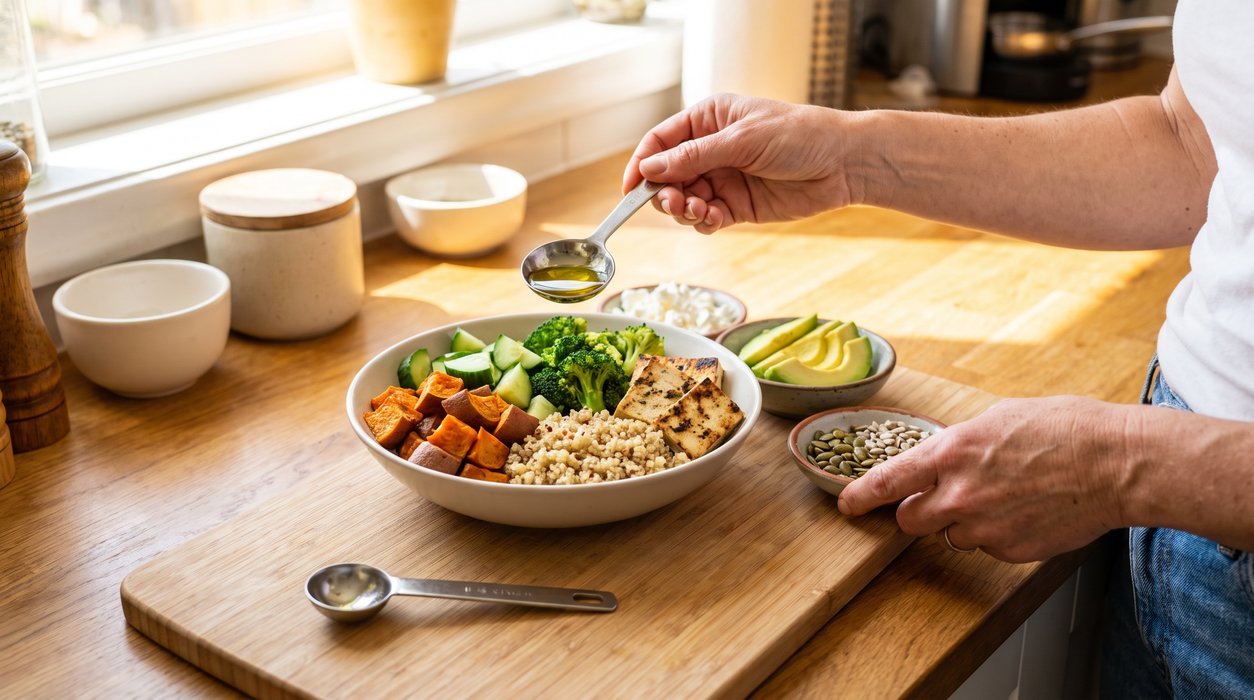
You prepare a meal with vegetables, lean protein, and whole grains, yet the final plate somehow contains far more energy than expected. This may not be random, and it does not mean you chose the wrong foods. The encouraging news: recognizing hidden calories in healthy meals can make portions easier to manage without removing nutritious ingredients.
Olive oil, avocado, nuts, seeds, hummus, pesto, and dressing can all belong in a balanced diet. The problem usually appears when several concentrated additions are poured, scooped, or sprinkled onto the same meal without a clear portion.
What causes hidden calories in healthy meals?
Hidden calories in healthy meals usually come from calorie-dense cooking fats, sauces, toppings, drinks, and repeated tastes. Each addition may look small, but several concentrated additions can accumulate before the meal reaches the table.
You do not need to count every calorie or stop using healthy fats. Measuring your most frequently used extras across several meals can help reveal where portions have gradually expanded.
Key Takeaways
- Nutritious foods can still be calorie-dense.
- Cooking oil, dressing, toppings, and sauces are commonly underestimated.
- Calorie stacking matters more than any single healthy ingredient.
- Choosing one or two rich additions can preserve flavor and satisfaction.
Quick Win: Measure the oil, dressing, nut butter, or sauce used in your next three meals. Compare the measured amount with your usual pour rather than trying to track your entire diet.
Why healthy foods can still be calorie-dense
“Healthy” describes nutritional qualities, not a guaranteed calorie range. A food may provide fiber, micronutrients, or unsaturated fats while also supplying substantial energy in a compact portion.
Fat is especially concentrated because it provides nine calories per gram, compared with four calories per gram from protein or carbohydrate.[1] Oils, nut butters, seeds, pesto, cheese, and creamy dressings can therefore change a meal quickly.
Foods rich in water and fiber usually provide more volume for their calorie content. Vegetables, whole fruit, broth-based soups, and many cooked legumes can help a plate feel more substantial without depending entirely on concentrated toppings.[2]
Calorie density is not the same as poor food quality. For a fuller explanation, see the difference between calories and nutrients.
Where extra calories accumulate
Cooking oil
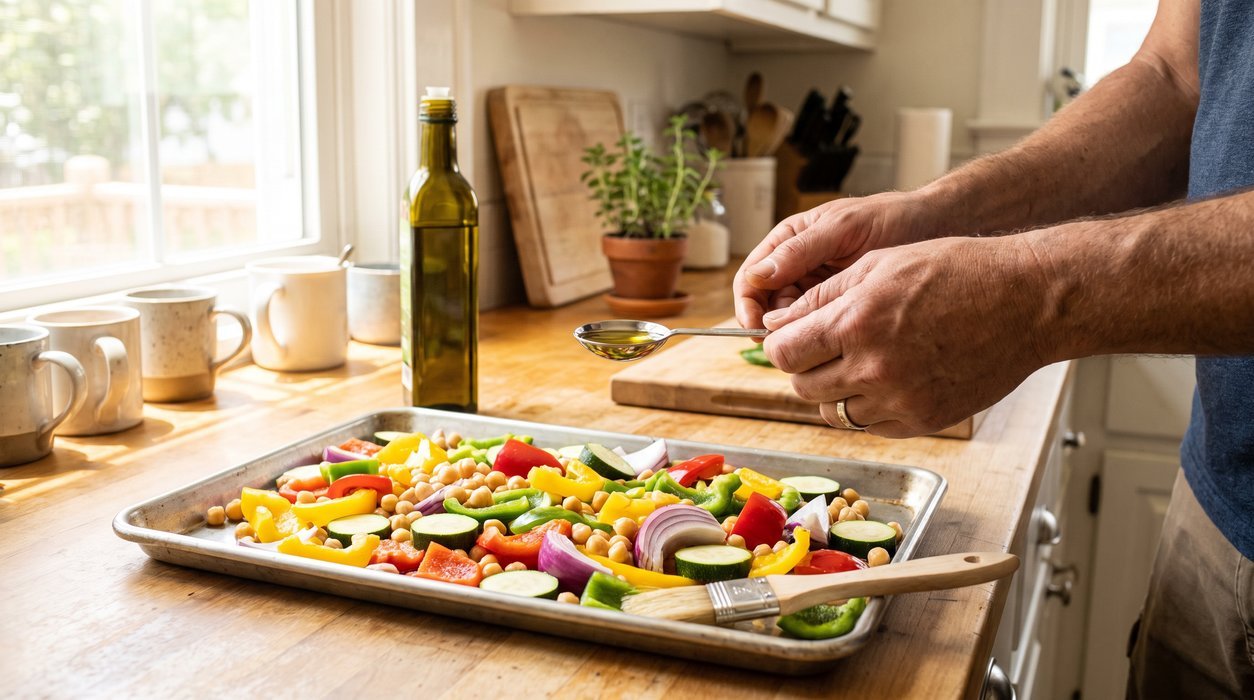
Olive oil and other plant oils can be useful sources of unsaturated fat. They are still almost entirely fat, and one tablespoon commonly supplies around 120 calories.
A quick pour may be considerably larger than one tablespoon. Oil used for sautéing, roasting, marinating, and finishing may also appear in several stages of the same recipe.
Dressings and sauces
A vinaigrette may be made from olive oil, lemon, herbs, and mustard, but most of its energy often comes from the oil. Creamy dressings, tahini sauces, mayonnaise, aioli, and pesto may be similarly concentrated.
The calories shown on a food label refer to the stated serving. Using twice that amount generally means consuming about twice the listed calories.[3]
Nuts, seeds, and nut butter
Nuts and seeds provide unsaturated fats, fiber, plant protein, and micronutrients. Their small size makes it easy to turn one portion into two or three without noticing.
Systematic reviews do not indicate that including nuts automatically causes weight gain. The practical distinction is whether they replace another food or are added to an already complete meal.[4]
Research also indicates that the metabolizable energy available from intact nuts may be lower than conventional calorie calculations suggest, partly because not all of their fat is fully accessible during digestion.[5]
Avocado, hummus, pesto, and cheese
These ingredients often carry a nutritional halo. Their reputation may make a generous portion feel insignificant, even when several are used together.
A grain bowl containing avocado, hummus, tahini dressing, seeds, cheese, and oil-roasted vegetables can include multiple concentrated fat sources. Each may fit individually, but the combined amount may be more than you intended.
Smoothie additions
A smoothie can become a large meal after adding nut butter, oats, chia seeds, yogurt, protein powder, dates, honey, and avocado. Because everything disappears into one glass, the additions may feel smaller than they are.
Decide whether the smoothie is a snack or a meal before building it. A meal-sized smoothie served alongside breakfast may unintentionally function as a second meal.
Tastes and cooking bites
A spoonful of sauce, a few nuts from the bag, a piece of cheese, and several tastes during cooking may not register as eating. Repeated most days, however, these bites can become a meaningful part of overall intake.
How calorie stacking happens
Calorie stacking occurs when several moderate additions are combined in one meal. No single ingredient appears excessive, but together the extras may supply as much energy as the meal’s protein, grains, and vegetables.
Consider a salad with chicken, avocado, feta, nuts, seeds, roasted chickpeas, oily dressing, and bread. It contains nourishing foods, yet several ingredients provide similar richness, crunch, or fat.
One thing worth pushing back on here: the usual assumption is that every nutritious ingredient should be added whenever possible. A balanced meal does not become more beneficial simply because it contains every healthy topping; choosing fewer additions can make portions clearer without lowering diet quality.
| Meal | Common stacking pattern | More intentional approach |
|---|---|---|
| Salad | Avocado, cheese, nuts, seeds, chickpeas, oil, and creamy dressing | Choose one main topping and a measured dressing |
| Grain bowl | Oil-roasted vegetables, hummus, tahini, avocado, and seeds | Use hummus or avocado, then add a lighter acidic sauce |
| Smoothie | Nut butter, oats, seeds, yogurt, dates, honey, and protein powder | Choose a simple meal recipe with one concentrated addition |
| Roasted vegetables | Oil before roasting, more oil after cooking, plus pesto or cheese | Measure the cooking oil and finish with herbs, citrus, or vinegar |
How to spot hidden calories in healthy meals
- Watch ingredients that are poured. Oil, dressing, cream, and sauces are difficult to estimate by eye.
- Notice repeated fat sources. Avocado, cheese, nuts, seeds, and dressing may overlap in the same meal.
- Check rounded spoonfuls. A heaped spoon of nut butter or hummus can be much larger than the label serving.
- Include preparation ingredients. Marinades, pan oil, tasting bites, and finishing sauces are part of the meal.
- Compare the meal with your hunger. A larger portion may be appropriate, but it should be a conscious choice rather than an invisible one.
This is not a personal failure. Humans are not naturally precise at estimating portions of oils, spreads, and small calorie-dense foods, especially when packaging and serving utensils provide no clear stopping point.
How to reduce excess calories without bland food
1. Choose the additions that matter most
Select one or two concentrated ingredients instead of using every available option. Avocado may be the best choice in a taco bowl, while feta and vinaigrette may matter more in a Greek-style salad.
2. Measure temporarily
Use a tablespoon or kitchen scale for your most frequently used oils, spreads, and dressings. The purpose is calibration, not permanent surveillance.
After several measured meals, you may begin to recognize how your usual pour or spoonful compares with the serving shown on the label. The useful change is greater awareness, not perfect accuracy.
3. Increase flavor with low-calorie intensity
Citrus, vinegar, mustard, garlic, fresh herbs, spices, pickled vegetables, chili, and salsa can create strong flavor. They allow a measured amount of oil or cream to spread further.
4. Toss instead of pouring
A small amount of dressing can coat a large salad when it is tossed thoroughly. Pouring dressing over the finished bowl often creates heavily dressed areas and dry areas, encouraging a second pour.
5. Serve sauces separately
Lightly dipping each bite can provide more control than covering the entire meal. This is especially useful with restaurant dressings, aioli, tahini sauce, and creamy dips.
6. Adjust the kitchen environment
Pre-portion nuts, keep measuring spoons near the stove, and store oils away from the immediate cooking area. Small environmental changes can make helpful portions easier at home.
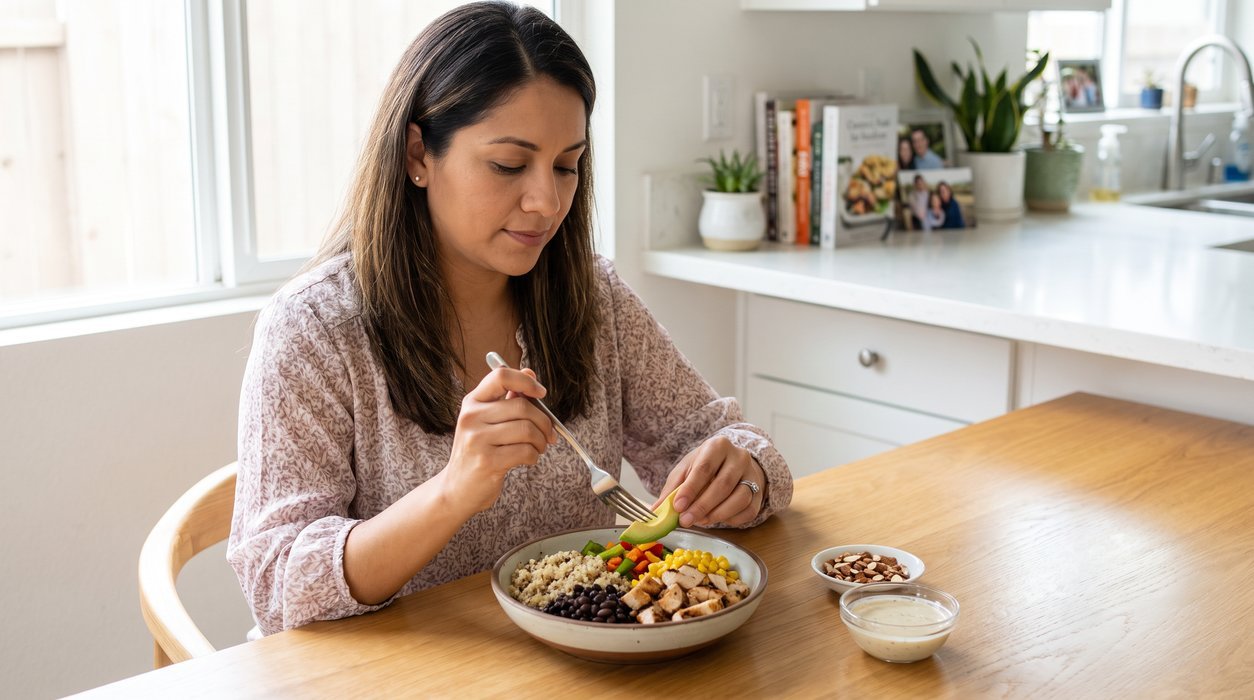
How to build a satisfying balanced meal
A lower-calorie meal is not automatically a better meal. A meal that lacks protein, fiber, carbohydrate, volume, or enjoyable flavor may leave you hungry soon afterward.
- Start with vegetables or fruit. Use a generous amount suited to the meal.
- Add a meaningful protein source. Options include fish, poultry, eggs, tofu, tempeh, yogurt, beans, or lentils.
- Include a fiber-rich carbohydrate. Whole grains, potatoes, beans, corn, and fruit can support fullness and energy.
- Select one or two concentrated additions. Choose oil, nuts, seeds, avocado, cheese, pesto, or creamy dressing intentionally.
- Adjust for real hunger. Activity, meal timing, body size, health needs, and appetite all influence an appropriate portion.
As you repeat these steps, the first useful changes may be fewer accidental pours, better meal satisfaction, and a clearer understanding of which additions are worth their portion. Changes in body weight or glucose patterns vary and should not be expected on a fixed schedule.
When portion tracking may help
You do not need to count every calorie. Begin with foods that are most difficult to estimate, including oils, dressings, nuts, spreads, cheese, sauces, drinks, and preparation bites.
A brief food record may help when meals seem balanced but hunger, weight, or glucose patterns are not responding as expected. Record what you actually used rather than what you planned to use.
Serving size is a standardized label reference, not a personal prescription. Your portion may reasonably differ according to hunger, activity, the rest of the meal, and individual nutritional requirements.[6]
Detailed tracking is not appropriate for everyone. Stop if measuring food increases anxiety, guilt, binge eating, rigid rules, or obsessive thoughts, and consider speaking with a registered dietitian or another qualified professional.
Food intake is also only one part of weight regulation. Sleep, physical activity, medications, medical conditions, environment, and genetics can all influence appetite or body weight.[7]
If you experience persistent unexplained weight change, extreme hunger, unusual fatigue, or other concerning symptoms, discuss them with a qualified healthcare professional rather than assuming that portion size is the only cause.
Frequently Asked Questions
What causes hidden calories in healthy meals?
Hidden calories in healthy meals usually come from unmeasured oil, dressing, sauces, nuts, seeds, spreads, cheese, drinks, and cooking bites. The issue is often several portions accumulating rather than one unhealthy ingredient.
Should I stop using olive oil to lose weight?
No. Olive oil can fit into a balanced eating pattern. Measuring it occasionally can help you use an intentional amount while still benefiting from its flavor and unsaturated fat.
Do nuts cause weight gain?
Systematic reviews have not found that adding nuts to controlled diets automatically causes weight gain. Portion and substitution still matter because nuts may either replace another food or simply add energy to the existing diet.[4]
How can I control portions without counting calories?
Plate foods instead of eating from containers, measure oils and spreads for a short learning period, and choose one or two concentrated toppings. Hunger, fullness, energy, and meal satisfaction can then provide additional feedback.
Conclusion
Healthy meals can contain more energy than expected when cooking oil, dressing, nuts, seeds, spreads, sauces, and toppings accumulate. The answer is not to fear nutritious food or make every meal as small as possible.
Start with the ingredient you are least likely to measure. Making one habitual pour or scoop visible can reduce hidden calories in healthy meals while preserving flavor, nutrition, and satisfaction.
Medical Disclaimer: The information provided in this article is for educational purposes only and does not constitute medical advice. Always consult a qualified healthcare provider before making changes to your diet, lifestyle, or treatment plan. TheMetabolicHub.com does not replace professional medical guidance.
References
- U.S. Food and Drug Administration. Interactive Nutrition Facts Label: Total Fat. FDA guidance on dietary fat
- Rolls BJ. Dietary energy density: Applying behavioural science to weight management. Physiology & Behavior. 2017. PMID: 29151813
- U.S. Food and Drug Administration. How to Understand and Use the Nutrition Facts Label. FDA serving-size guidance
- Nishi SK, Viguiliouk E, Blanco Mejia S, et al. Are fatty nuts a weighty concern? A systematic review and meta-analysis. Obesity Reviews. 2021. PMID: 34494363
- Nikodijevic CJ, Probst YC, Batterham MJ, Tapsell LC, Neale EP. The Metabolizable Energy and Lipid Bioaccessibility of Tree Nuts and Peanuts. Advances in Nutrition. 2023. PMID: 36934832
- National Institute of Diabetes and Digestive and Kidney Diseases. Food Portions: Choosing Just Enough for You. NIDDK portion guidance
- National Institute of Diabetes and Digestive and Kidney Diseases. Factors Affecting Weight & Health. NIDDK overview of factors affecting weight and health