Metabolic Syndrome in Women: A Guide to Risks and What You Can Do

The tiredness that doesn’t go away after a full night’s sleep. The weight that settles around the middle no matter what gets tried. The blood pressure reading that keeps creeping up at annual checkups. These aren’t random inconveniences — and they’re not inevitable either.
For many women, these signs cluster together for a reason. This may not be a matter of aging or bad luck — it may signal metabolic syndrome in women, a pattern of overlapping risk factors that significantly raises the chance of heart disease and type 2 diabetes.
The encouraging news: metabolic syndrome in women is well-researched, measurable, and — with the right information — highly actionable. This guide covers what it is, how it’s diagnosed, and what evidence-based steps may help improve the picture.
Table of Contents
- What Is Metabolic Syndrome in Women?
- How It’s Diagnosed
- Key Risk Factors and Unique Modifiers
- The Role of Insulin Resistance
- Lifestyle Strategies That May Help
- Monitoring and Prevention
- Frequently Asked Questions
Key Takeaways
- Metabolic syndrome is diagnosed when 3 of 5 specific markers are present — not a single test
- For women, a waist circumference above 35 inches (88 cm) is one of the defining criteria
- Hormonal factors — including PCOS and gestational diabetes history — can meaningfully raise risk
- Lifestyle changes, particularly diet quality and sleep, are among the most evidence-backed interventions
- Even modest improvements in individual markers can reduce overall cardiovascular risk
What Metabolic Syndrome in Women Actually Means

Metabolic syndrome in women is not a single disease. It’s a cluster — a combination of five specific health markers that, when three or more are present at the same time, signal a significantly elevated risk for cardiovascular disease and type 2 diabetes.[1]
Those five markers are: elevated fasting blood sugar, high triglycerides, low HDL (“good”) cholesterol, high blood pressure, and excess abdominal fat — measured by waist circumference.
No single marker is the problem on its own. The risk compounds when they appear together. Research estimates that roughly one in four U.S. adults meets the criteria — and prevalence increases significantly with age.[2]
| Marker | What It Reflects | Why It Matters |
|---|---|---|
| Elevated Fasting Blood Sugar | Impaired glucose regulation | Early sign of insulin resistance; precursor to type 2 diabetes |
| High Triglycerides | Excess fat in the bloodstream | Linked to arterial inflammation and cardiovascular strain |
| Low HDL Cholesterol | Reduced “good” cholesterol | HDL helps clear arterial plaque; low levels increase heart risk |
| High Blood Pressure | Increased cardiovascular load | Strains blood vessels over time; often silent for years |
| Excess Abdominal Fat | Central obesity (waist >35 in / 88 cm in women) | Visceral fat drives inflammation and impairs insulin signaling |
How Metabolic Syndrome Is Diagnosed
Diagnosis doesn’t require a specialized test. A doctor looks for 3 of the 5 markers listed above, using standard measurements: a blood panel (lipids, fasting glucose), a blood pressure reading, and a waist circumference measurement.[2]
The most widely used framework in the U.S. comes from the American Heart Association and the National Heart, Lung, and Blood Institute (NHLBI). For women specifically, the waist circumference threshold is set at greater than 35 inches (88 cm).
| Criteria Set | Waist Threshold (Women) | Diagnostic Requirement |
|---|---|---|
| ATP III / AHA–NHLBI | >88 cm (35 in) | Any 3 of 5 markers |
| IDF (International Diabetes Federation) | ≥80 cm (31.5 in) | Central obesity + any 2 of remaining 4 markers |
The lower IDF threshold reflects evidence that risk can appear at smaller waist measurements in certain populations. If there’s any question about which criteria apply, it’s worth discussing both with a doctor — particularly for women of Asian or Hispanic descent, where the IDF threshold may be more relevant.
One important note: “white coat hypertension” — blood pressure that reads high in a clinical setting but normalizes elsewhere — is more frequently documented in women. A single elevated reading doesn’t confirm the marker. If office readings are consistently elevated, 24-hour ambulatory monitoring gives a more accurate picture of true daily blood pressure.
Risk Factors and Hormonal Modifiers Specific to Women
Several factors influence metabolic syndrome risk in ways that are particularly relevant to women’s physiology and reproductive history.
PCOS (Polycystic Ovary Syndrome) is one of the strongest. It affects roughly 6–7% of premenopausal women — and among those with PCOS, the prevalence of metabolic syndrome runs between 43% and 47%, approximately twice the rate seen in the general population.[3] The connection runs through insulin resistance: PCOS disrupts insulin signaling, which in turn elevates androgens, disrupts ovulation, and promotes abdominal fat storage. It’s a bidirectional relationship, not a simple cause-and-effect chain.
Gestational diabetes is another significant signal. Roughly 7% of pregnancies involve gestational diabetes — and women who experience it face a meaningfully higher lifetime risk of developing type 2 diabetes and metabolic syndrome. Reproductive history belongs in any metabolic health conversation with a doctor.
Breastfeeding duration shows a protective association in the research: each additional year of lactation is linked to a lower risk of developing type 2 diabetes, and women who breastfed for more than one month show a measurable reduction in metabolic syndrome risk compared to those who did not.
This cycle can develop quietly over years — which is why so many women are caught off guard when a doctor first mentions it. It is not a personal failure. These are physiological patterns shaped by hormones, genetics, and life history, not lifestyle choices alone.
Menopause also shifts the metabolic landscape. The decline in estrogen that accompanies perimenopause and menopause is associated with increased visceral fat deposition and changes in lipid profiles — even without significant changes in total body weight. This is a window where proactive monitoring matters more than usual.
The Role of Insulin Resistance — and Why It’s Central

Insulin resistance sits at the core of metabolic syndrome. Understanding it helps explain why the five markers tend to appear together rather than in isolation.
When cells become less responsive to insulin — the hormone that signals cells to take up glucose from the bloodstream — the pancreas compensates by producing more of it. This elevated insulin level (hyperinsulinemia) has downstream effects throughout the body: it promotes fat storage (particularly visceral fat), raises triglycerides, suppresses HDL, and contributes to elevated blood pressure through its effects on the kidneys and nervous system.
A useful marker is HOMA-IR — a calculated score derived from fasting glucose and fasting insulin levels. It’s not always included in standard panels, but it’s worth requesting specifically. A higher HOMA-IR score indicates greater insulin resistance and is often an earlier signal than fasting glucose alone.
One thing worth pushing back on here: the standard advice to simply reduce carbohydrates is only part of the picture. Research suggests that sleep quality may have an equally significant — and in some studies, greater — effect on insulin sensitivity than dietary changes alone. One week of sleep restricted to under 6 hours per night has been shown to reduce insulin sensitivity by 30–40%.[4] Sleep deprivation also raises cortisol and ghrelin, both of which compound insulin resistance. Most metabolic health guides lead with food. Sleep belongs in the same conversation.
Post-meal glucose dynamics are another underappreciated piece. Standard fasting glucose tests can appear normal while postprandial spikes — the glucose surges that occur after eating — are already elevated. For women with a history of gestational diabetes or PCOS, asking a doctor about postprandial testing alongside fasting panels gives a more complete picture.
Lifestyle Strategies That May Support Improvement in Metabolic Markers
The research on lifestyle intervention for metabolic syndrome in women is fairly consistent: dietary quality, regular movement, and sleep are the three levers with the strongest evidence base.
Diet: The Mediterranean dietary pattern has the most robust support. The PREDIMED trial found it superior to a low-fat diet for reducing metabolic syndrome components — with reversion (full resolution of the diagnosis) observed in up to 14% of participants over follow-up.[5] In practical terms, this means: leafy greens, broccoli, peppers, and zucchini as the base; olive oil rather than seed oils; fatty fish 2–3 times per week; legumes; and a meaningful reduction in sugar-sweetened beverages, which drive visceral fat accumulation through hepatic de novo lipogenesis.
Movement: The AHA recommends at least 150 minutes of moderate-intensity movement per week — roughly 20–25 minutes daily. That baseline is achievable. What’s often overlooked is timing: a 10-minute walk after a meal has been shown to reduce postprandial glucose more effectively than a single longer walk earlier in the day.[6] For women managing blood sugar, meal-paired movement is a practical, low-barrier tool.
Sleep: Seven to nine hours of quality sleep per night is not optional for metabolic health — it’s a clinical variable. As noted above, even one week of insufficient sleep measurably impairs glucose tolerance. Addressing sleep hygiene belongs alongside dietary changes in any management plan.
Weight loss, where applicable: Even a 5–7% reduction in body weight — roughly 8–12 lbs for a 160 lb woman — has been associated with meaningful improvements in fasting glucose, triglycerides, and blood pressure. The goal doesn’t need to be dramatic to be effective.
Monitoring and Prevention

Metabolic syndrome develops gradually, and most of its markers are silent until they’re not. Regular screening turns that from a liability into an advantage.
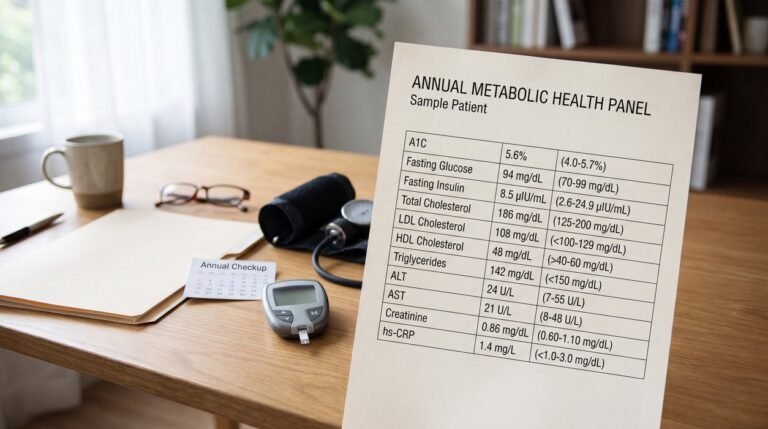
The core panel worth requesting at annual visits: fasting lipids (triglycerides, HDL, LDL), fasting glucose, blood pressure, and waist circumference. For women with PCOS, a history of gestational diabetes, or a family history of type 2 diabetes, adding fasting insulin (for HOMA-IR calculation) and a postprandial glucose check gives a more complete picture.
Tracking these numbers over time — even in a simple notes app — creates a personal baseline. A single elevated reading means less than a trend. Patterns spotted early are far easier to address than those that compound over years.
Conclusion
Metabolic syndrome in women is common, measurable, and — for most people — highly responsive to evidence-based lifestyle changes. The markers don’t have to move dramatically to make a meaningful difference in long-term risk.
Understanding what to track, and why, is genuinely half the work. A waist measurement, a fasting blood panel, and an honest conversation with a doctor about hormonal history can clarify a great deal. None of this requires perfection — it requires a direction.
Small, consistent changes in food quality, daily movement, and sleep add up faster than most people expect. The research supports it. So does the physiology.
Medical Disclaimer: The information provided in this article is for educational purposes only and does not constitute medical advice. Always consult a qualified healthcare provider before making changes to your diet, lifestyle, or treatment plan. TheMetabolicHub.com does not replace professional medical guidance.
References
- Ford ES, Giles WH, Dietz WH. Prevalence of the metabolic syndrome among US adults. JAMA. 2002.
PMID: 12782834 - Grundy SM et al. Diagnosis and management of the metabolic syndrome. Circulation. 2005.
PMID: 16157828 | NHLBI — Metabolic Syndrome - Moran LJ et al. Metabolic syndrome in polycystic ovary syndrome. Hum Reprod Update. 2010.
PMID: 18997196 - Spiegel K et al. Sleep curtailment in healthy young men is associated with decreased leptin levels, elevated ghrelin levels, and increased hunger and appetite. Ann Intern Med. 2004.
PMID: 16227462 - Estruch R et al. Primary prevention of cardiovascular disease with a Mediterranean diet (PREDIMED). N Engl J Med. 2018.
PMID: 29897866 - Buffey AJ et al. The acute effects of interrupting prolonged sitting with light-intensity walking on postprandial glycemia. Sports Medicine. 2022.
PMID: 35115009 - American Heart Association — Metabolic Syndrome
Frequently Asked Questions
What is metabolic syndrome in women?
Metabolic syndrome in women is a cluster of five interrelated health markers — elevated fasting blood sugar, high triglycerides, low HDL cholesterol, high blood pressure, and excess abdominal fat — that, when three or more are present simultaneously, significantly raise the risk for cardiovascular disease and type 2 diabetes. It’s not a single disease with a single cause, but a pattern that reflects underlying disruptions in insulin sensitivity and fat metabolism. Because the individual markers are often asymptomatic, many women aren’t aware they meet the criteria until a doctor reviews a full blood panel alongside a waist measurement.
How does PCOS increase metabolic syndrome risk?
PCOS (Polycystic Ovary Syndrome) is strongly linked to insulin resistance, which is the central driver of metabolic syndrome. When the body’s cells don’t respond efficiently to insulin, the pancreas produces more of it — and elevated insulin levels raise androgen production, disrupt ovulation, and promote visceral fat accumulation. Studies show that 43–47% of women with PCOS meet the criteria for metabolic syndrome, roughly double the rate in the general population. For women with PCOS, regular metabolic screening — including fasting insulin, not just glucose — is particularly valuable.
Can metabolic syndrome be improved with lifestyle changes?
Research suggests that lifestyle changes are among the most effective tools available for improving metabolic markers. The PREDIMED trial found that a Mediterranean dietary pattern was associated with full resolution of metabolic syndrome criteria in up to 14% of participants. Beyond diet, consistent movement — particularly after meals — and adequate sleep (7–9 hours per night) have both demonstrated meaningful effects on insulin sensitivity, blood pressure, and triglyceride levels. Even modest weight loss of 5–7% of body weight may support measurable improvements across multiple markers.
What waist measurement indicates risk for women?
Under the widely used AHA–NHLBI criteria, a waist circumference greater than 35 inches (88 cm) is the threshold for the abdominal obesity criterion in women. The International Diabetes Federation uses a lower threshold of 31.5 inches (80 cm), which may be more relevant for women of Asian or Hispanic descent. Waist circumference is a more precise predictor of metabolic risk than BMI because it specifically reflects visceral fat — the metabolically active fat stored around abdominal organs, which is more directly linked to insulin resistance and inflammation than subcutaneous fat stored elsewhere.
What tests should women ask for at their annual checkup?
A practical baseline panel includes: fasting lipids (triglycerides, HDL, LDL), fasting glucose, blood pressure, and waist circumference measured at the appointment. For women with PCOS, a history of gestational diabetes, or a family history of type 2 diabetes, it’s worth requesting fasting insulin as well — this allows a HOMA-IR score to be calculated, which is a more sensitive early marker of insulin resistance than fasting glucose alone. Postprandial glucose testing (measuring blood sugar 1–2 hours after a meal) may also offer additional insight that fasting tests miss.