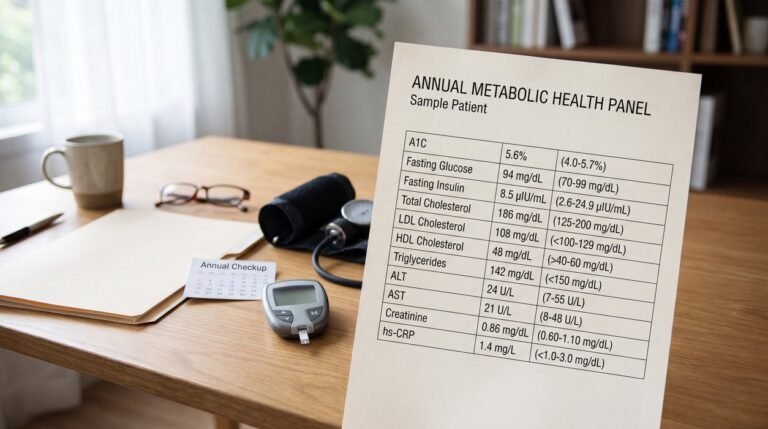
Metabolic Syndrome and Sleep Disorders: The Bidirectional Link

You wake up exhausted — again. The alarm goes off, you’ve technically slept, but something still feels off: energy is low, cravings hit hard by mid-morning, and brain fog follows you into the afternoon.
This pattern may not be random. Poor sleep and metabolic syndrome don’t just coexist — they actively worsen each other in ways that go well beyond feeling tired.
The encouraging news: understanding the link between metabolic syndrome and sleep disorders is one of the most actionable things you can do for your long-term health. This guide walks through the research, the mechanisms, and what you can actually do about it.
In This Article
- What Is the Link Between Metabolic Syndrome and Sleep Disorders?
- Understanding Metabolic Syndrome
- How Sleep Disruption Affects Metabolism
- Sleep Duration and Metabolic Risk
- Circadian Misalignment and Metabolism
- Obstructive Sleep Apnea and Metabolic Risk
- Insomnia and Cardiometabolic Risk
- What Actually Helps: Practical Steps
- Who Is Most at Risk?
- Frequently Asked Questions
What Is the Link Between Metabolic Syndrome and Sleep Disorders?
Metabolic syndrome and sleep disorders are bidirectionally linked — each one raises the risk of the other. Poor sleep triggers hormonal and inflammatory changes that promote insulin resistance, elevated blood pressure, and weight gain around the midsection.
At the same time, the connection between metabolic syndrome and sleep disorders runs in both directions: metabolic dysfunction disrupts sleep architecture, making restorative rest harder to achieve. Research tracking over ten million individuals found that irregular sleep patterns are a consistent predictor of metabolic risk markers developing over time.[1]
Concretely: adults sleeping fewer than 7 hours per night show measurably higher fasting glucose and greater appetite-hormone disruption than those sleeping 7–9 hours.[5]
| Sleep Issue | Metabolic Impact |
|---|---|
| Short sleep (<7h) | Elevated fasting glucose, increased ghrelin, higher visceral fat accumulation |
| Insomnia | Elevated blood pressure, unfavorable LDL/HDL ratio, cortisol dysregulation |
| Obstructive sleep apnea | Intermittent hypoxia → insulin resistance, inflammation, blood sugar instability |
| Circadian misalignment | Disrupted glucose metabolism, increased cardiometabolic risk, weight gain |
Understanding Metabolic Syndrome
Metabolic syndrome isn’t a single disease. It’s a cluster of five specific risk markers — and having three or more of them at once significantly raises the risk of heart disease and type 2 diabetes.
The five markers, as defined by the AHA/NHLBI, are: elevated waist circumference, high triglycerides, low HDL cholesterol, elevated blood pressure, and high fasting glucose.
| Marker | Threshold (AHA/NHLBI) |
|---|---|
| Waist circumference | >40 inches (men) / >35 inches (women) |
| Triglycerides | ≥150 mg/dL |
| HDL cholesterol | <40 mg/dL (men) / <50 mg/dL (women) |
| Blood pressure | ≥130/85 mmHg |
| Fasting glucose | ≥100 mg/dL |
Prevalence has risen sharply: research suggests the rate in U.S. adults climbed from roughly 25% in the late 1980s to nearly 37% by 2016. That’s more than one in three American adults.[2]
Many of those risk markers are directly worsened by poor sleep — which is exactly why this connection matters. For a full breakdown of the five criteria, see the metabolic syndrome criteria explained.
How Sleep Disruption Affects Metabolism
Poor sleep doesn’t passively sit alongside metabolic dysfunction — it actively drives it through several biological pathways.
The central mechanism is inflammation. Insufficient sleep triggers a low-grade, body-wide inflammatory state, elevating markers like C-reactive protein (CRP) and pro-inflammatory cytokines. Over time, this inflammation makes cells less responsive to insulin.[3]
The hormone picture compounds the problem:
- Cortisol remains elevated at night instead of dropping — promoting fat storage and raising blood sugar
- Insulin becomes less effective, leading to higher fasting glucose even without dietary changes
- Ghrelin (hunger hormone) rises; leptin (satiety hormone) drops — increasing appetite, especially for calorie-dense foods
One well-replicated finding: just one week of restricted sleep (5–6 hours) reduced insulin sensitivity by 30–40% in healthy adults.[8] That’s not a marginal effect.

| Hormone | Normal Role | Effect of Poor Sleep |
|---|---|---|
| Cortisol | Manages stress and energy; normally low at night | Stays elevated, promotes blood sugar release and visceral fat storage |
| Insulin | Moves glucose from blood into cells | Effectiveness drops — fasting glucose rises even with unchanged diet |
| Ghrelin / Leptin | Regulate hunger and fullness | Ghrelin rises, leptin falls — increased appetite and cravings |
Sleep Duration and Metabolic Risk
The 7-to-9-hour range isn’t arbitrary — it’s where metabolic regulation works best. Both falling short of 7 hours and consistently exceeding 9 hours are associated with worse metabolic markers.[5]
Short sleep is the more common problem. In adults getting under 7 hours regularly, research documents higher fasting glucose, greater visceral fat accumulation, and unfavorable lipid profiles. Think of consistent sleep as a non-negotiable part of metabolic maintenance — on par with diet quality.
| Sleep Duration | Metabolic Impact | Key Consideration |
|---|---|---|
| Less than 7 hours | Higher fasting glucose, increased appetite, visceral fat accumulation | Most common pattern in US adults; raises all five MetS markers |
| 7 to 9 hours | Stable energy regulation, hormone balance, healthy lipid profile | Optimal range for most adults |
| More than 9 hours | Associated with poorer metabolic markers in some populations | May signal an underlying issue — worth discussing with a doctor |
Circadian Misalignment and Metabolism
When eating and sleeping patterns don’t align with your body’s internal clock, metabolic strain follows — even if total sleep hours look adequate on paper.
About 15% of the U.S. workforce does shift work. For these adults, the body is repeatedly asked to process meals and regulate glucose during its designated “repair window.” The result is measurably worse insulin sensitivity and higher blood pressure compared to day-shift workers.
Social Jetlag
Social jetlag describes the mismatch between your biological clock and your social schedule. If you consistently stay up later on weekends and sleep in, you’re essentially flying across time zones twice a week — without the trip.
Even one to two hours of chronic weekend schedule drift is associated with higher fasting glucose and greater waist circumference in population studies. Your body’s metabolic timing is more sensitive than most people realize.
Night owls face a particular challenge: standard work schedules force early wake times that conflict with their natural rhythm. The cumulative sleep debt — and the circadian disruption that comes with it — contributes meaningfully to long-term cardiometabolic risk.
Obstructive Sleep Apnea and Metabolic Risk
Obstructive sleep apnea (OSA) causes the airway to repeatedly collapse during sleep, dropping blood oxygen levels sharply with every episode. The body treats each oxygen dip as an emergency — releasing stress hormones, activating inflammatory pathways, and disrupting deep sleep stages.
This cascade directly worsens insulin resistance. Research confirms that the cycles of intermittent hypoxia trigger cytokine release (including IL-6 and TNF-α) and elevate C-reactive protein — the same inflammatory markers associated with metabolic syndrome progression.[4]
| OSA Effect | Inflammatory Response | Metabolic Impact |
|---|---|---|
| Sharp drop in blood oxygen | IL-6, TNF-α cytokine release | Increased insulin resistance |
| Stress hormone activation | Elevated CRP | Blood sugar instability, visceral fat |
| Oxidative stress | Immune cell activation | Higher triglycerides, lower HDL |
One thing worth pushing back on here: CPAP therapy is highly effective for OSA and improves sleep quality significantly. But research shows it does not automatically resolve the metabolic risk factors that have already developed.
Addressing OSA is a necessary step — but the dietary, physical activity, and sleep hygiene changes described below matter equally for metabolic recovery. Treating the airway issue is the beginning, not the finish line.
If you suspect breathing irregularities during sleep — loud snoring, waking unrefreshed, morning headaches — a sleep study is worth requesting from your doctor. OSA frequently goes undiagnosed for years.
Insomnia and Cardiometabolic Risk
Chronic insomnia — difficulty falling or staying asleep at least three nights per week for more than three months — affects an estimated 10–15% of U.S. adults. The metabolic consequences go well beyond fatigue.
Persistent insomnia keeps the nervous system in a low-level alert state. Blood pressure tends to run higher. LDL cholesterol may rise while HDL dips. Fasting glucose climbs gradually, often without obvious dietary explanation.
This cycle can develop quietly over years — which is why so many people are caught off guard when a doctor mentions prediabetes or elevated blood pressure. It is not a personal failure. It’s a physiological response to sustained stress on the body’s regulatory systems.
| Insomnia State | Blood Pressure Impact | Lipid Profile Impact |
|---|---|---|
| Unmanaged | Consistently elevated readings | Higher LDL, lower HDL trend |
| Partially managed | Readings fluctuate, improve with consistency | Lipid levels begin stabilizing |
| Well-managed | Normalizes over time | Healthier lipid profile maintained |
Cognitive behavioral therapy for insomnia (CBT-I) is the first-line treatment recommended by sleep medicine specialists — not sleep medication. It addresses the thought patterns and behavioral habits that perpetuate insomnia, with lasting results in most people who complete a full course.
What Actually Helps: Managing Metabolic Syndrome and Sleep Disorders Together
The research on metabolic syndrome and sleep disorders is more encouraging than most people expect. Sleep improvements show measurable metabolic effects within weeks — not months.
Start with the highest-leverage habits first:
- Consistent sleep and wake times — including weekends. This single change reduces social jetlag and stabilizes cortisol rhythm within 1–2 weeks for most people.
- A 10–15 minute walk after the largest meal of the day. Post-meal movement blunts glucose spikes and supports insulin sensitivity — and it takes nothing away from sleep quality when done earlier in the evening.
- Protein at breakfast — eggs, Greek yogurt, cottage cheese, or skyr. A protein-anchored first meal reduces morning glucose swings and moderates appetite into the afternoon.
- Limit screens and food after 9 PM. Late-night light exposure suppresses melatonin; late eating shifts glucose metabolism into a less efficient window.
- Cool, dark bedroom. Room temperature around 65–68°F is associated with deeper slow-wave sleep and improved overnight glucose regulation.
Many people report noticeable improvements in afternoon energy within the first 1–2 weeks of consistent sleep timing — before any major dietary changes. The post-meal crash that often signals blood sugar instability tends to lessen. Morning hunger becomes more predictable.
For measurable metabolic improvements — fasting glucose, blood pressure, triglycerides — research points to timelines of 8–12 weeks of sustained changes. That’s a realistic window: not a quick fix, but not years either.
For those with suspected sleep apnea or chronic insomnia resistant to behavioral approaches, a referral to a sleep specialist is the right next step. CBT-I and CPAP are the most evidence-supported clinical interventions for their respective conditions. See the early metabolic syndrome signs worth monitoring alongside sleep improvement.

Who Is Most at Risk?
Both conditions — sleep disorders and metabolic syndrome — disproportionately affect certain groups.
Age is a clear factor. The risk of both OSA and metabolic dysfunction increases significantly after 40, with prevalence peaking in the 50–70 range. Hormonal shifts during perimenopause and menopause also alter sleep architecture and metabolic regulation simultaneously.
Research suggests variations in risk across ethnic groups, with Black and Hispanic adults showing higher rates of both OSA and metabolic syndrome in U.S. population studies — partly reflecting disparities in access to screening and treatment.[7]
Adolescents aren’t exempt. Studies tracking young people with sleep-disordered breathing found elevated rates of metabolic syndrome markers — suggesting these pathways activate earlier in life than often assumed.
For anyone with a family history of type 2 diabetes, cardiovascular disease, or obesity, proactive attention to sleep quality is especially warranted. These aren’t separate risk factors — they operate through shared mechanisms.
If you’re in a higher-risk group, asking your doctor about a fasting insulin test alongside standard cholesterol screening can provide an earlier picture of metabolic trajectory. [Interner Link auf /sleep-and-prediabetes/ hier manuell setzen nach Publikation]
Conclusion
The connection between metabolic syndrome and sleep disorders runs deeper than most people — and many clinicians — address in routine care. Sleep isn’t recovery time tacked onto your health plan. It is part of the mechanism.
What the research consistently shows: improving sleep quality and duration is one of the few interventions that moves multiple metabolic markers at once — blood pressure, fasting glucose, inflammatory markers, and appetite regulation. That’s a meaningful return on a behavioral change most people can actually make.
Start with consistent sleep timing, a protein-anchored breakfast, and a short post-meal walk. Give it 2–4 weeks. The changes are measurable — and they build on each other.
Frequently Asked Questions
What is the link between metabolic syndrome and sleep disorders?
Metabolic syndrome and sleep disorders are bidirectionally linked — each actively worsens the other. Poor sleep disrupts insulin regulation, elevates cortisol, and promotes inflammation, which drives the five core markers of metabolic syndrome: high blood pressure, elevated fasting glucose, low HDL, high triglycerides, and excess waist circumference. At the same time, conditions like sleep apnea and insomnia are more common in people who already have metabolic dysfunction, creating a reinforcing cycle that often goes unaddressed in standard care.
How does obstructive sleep apnea affect metabolic health?
OSA causes repeated oxygen drops throughout the night. Each episode triggers a stress response — cortisol surges, inflammatory markers rise, and insulin sensitivity drops. Over time, this contributes to insulin resistance, visceral fat accumulation, and elevated blood pressure. Research shows the inflammatory cytokines released during intermittent hypoxia are the same ones associated with metabolic syndrome progression. Treating OSA with CPAP improves sleep quality significantly, though metabolic risk factors also require targeted lifestyle intervention to resolve fully.
Can improving sleep actually improve metabolic markers?
Yes — and the evidence is fairly direct. Research shows that consistent sleep in the 7–9 hour range is associated with lower fasting glucose, better lipid profiles, and reduced blood pressure compared to shorter sleep duration. In intervention studies, improving sleep quality improved insulin sensitivity within weeks. This makes sleep one of the few behavioral changes that moves multiple metabolic markers simultaneously — without requiring major dietary overhauls as a first step.
What practical steps help both sleep and metabolic health at the same time?
The highest-overlap habits are consistent sleep and wake times (including weekends), a protein-rich breakfast of eggs, Greek yogurt, or cottage cheese to anchor blood sugar from the morning, and a 10–15 minute walk after dinner to reduce post-meal glucose spikes while supporting sleep onset. Limiting food and bright screens after 9 PM helps both overnight glucose regulation and melatonin production. These changes tend to show measurable effects in energy and blood sugar stability within 1–2 weeks.
Who is most at risk for both sleep disorders and metabolic syndrome?
Risk increases with age, particularly after 40. People with excess abdominal weight are more likely to develop both obstructive sleep apnea and insulin resistance. Shift workers face elevated risk due to chronic circadian disruption. Research also points to higher rates in Black and Hispanic adults in the U.S., partly reflecting screening disparities. A family history of type 2 diabetes, cardiovascular disease, or obesity is a meaningful signal to be proactive about both sleep quality and metabolic monitoring.
Medical Disclaimer: The information provided in this article is for educational purposes only and does not constitute medical advice. Always consult a qualified healthcare provider before making changes to your diet, lifestyle, or treatment plan. TheMetabolicHub.com does not replace professional medical guidance.
References
- Liu Z et al. Sleep Disturbances and Metabolic Syndrome. Frontiers in Endocrinology. 2021. DOI: 10.3389/fendo.2021.773646
- National Heart, Lung, and Blood Institute. Metabolic Syndrome. NHLBI. nhlbi.nih.gov
- Mullington JM et al. Cardiovascular, Inflammatory and Metabolic Consequences of Sleep Deprivation. PMC9839511. PMC9839511
- Drager LF et al. Obstructive Sleep Apnea and Metabolic Syndrome. PMID: 36863747
- Chaput JP et al. Sleep Duration and Metabolic Regulation. PMC8640251. PMC8640251
- American Heart Association. Metabolic Syndrome. heart.org
- PMC12143987. Demographic Variations in Sleep and Metabolic Risk. PMC12143987
- Spiegel K et al. Sleep Curtailment and Endocrine and Metabolic Function. Journal of Applied Physiology. PMID: 16227462