
Metabolic Lab Tests: 5 Yearly Checks for Adults
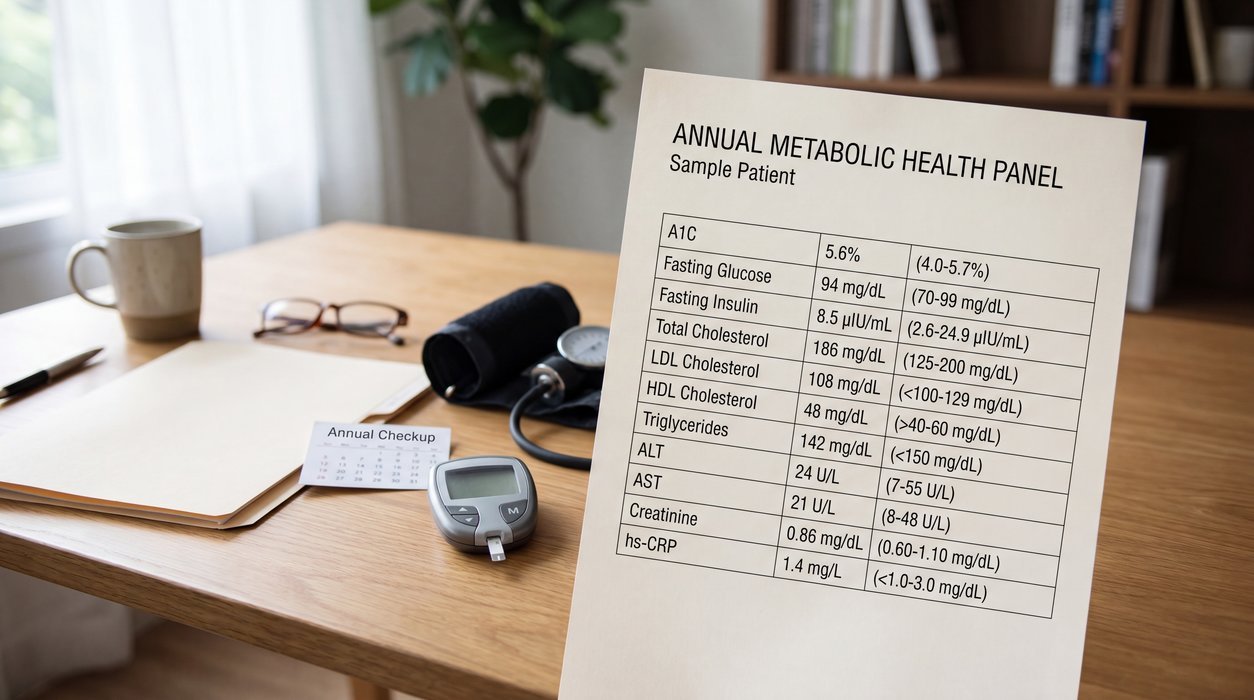
Feeling mostly fine can make annual labs seem optional, especially when life is already full. But early shifts in blood sugar, lipids, liver enzymes, kidney markers, and inflammation can be quiet. The encouraging news: metabolic lab tests can turn vague concerns into a clearer yearly conversation with your healthcare provider.
Quick Win: Before your next appointment, write down your last 3 months of energy changes, sleep quality, waist changes, cravings, blood pressure readings if available, medications, and family history. Bring that list when asking which labs make sense this year.
Which metabolic lab tests should adults discuss yearly?
The five metabolic lab tests or lab categories worth discussing during a yearly checkup are A1C, fasting glucose with possible fasting insulin, a lipid panel, a comprehensive metabolic panel, and hs-CRP when appropriate. Together, they can help show patterns in glucose regulation, insulin demand, cholesterol, triglycerides, liver and kidney function, and inflammation.
Metabolic lab tests do not replace a physical exam, symptoms review, blood pressure measurement, medication review, or family history. They work best as a yearly map that helps you and a qualified healthcare provider decide what deserves attention now, what should be repeated, and what can simply be tracked.
| Lab Test | What It Helps Show | Why Adults Ask About It |
|---|---|---|
| A1C | Average blood glucose over about the past 3 months | May help screen for prediabetes or diabetes risk patterns |
| Fasting glucose plus possible fasting insulin | Morning glucose and how much insulin may be needed to manage it | May add context when insulin resistance is suspected |
| Lipid panel | Total cholesterol, LDL cholesterol, HDL cholesterol, and triglycerides | Helps assess cardiovascular and metabolic risk patterns |
| Comprehensive metabolic panel | Glucose, electrolytes, kidney markers, liver enzymes, proteins, and minerals | Can flag liver, kidney, and chemistry changes that deserve follow-up |
| hs-CRP | Low-grade inflammation linked with cardiovascular risk context | May add useful information when interpreted with other risk factors |
Key takeaways
- Yearly labs are most useful when compared with prior results, not judged as one isolated snapshot.
- A1C and fasting glucose show different parts of blood sugar regulation.
- Fasting insulin is not a routine screening test for everyone, but it may help when insulin resistance is suspected.
- Triglycerides, HDL cholesterol, liver enzymes, and kidney markers can add important metabolic context.
- One borderline result is not a verdict. Repeated patterns are usually more meaningful.
Why A1C and fasting glucose belong in the conversation
A1C is one of the most familiar blood sugar markers because it reflects average glucose exposure over roughly the past 3 months. The CDC lists A1C below 5.7% as normal, 5.7% to 6.4% as the prediabetes range, and 6.5% or higher as the diabetes range, with clinical confirmation needed for diagnosis.[1]
Fasting glucose gives a more immediate snapshot. It measures blood sugar after not eating overnight, which can help show how the body is regulating glucose before breakfast or other morning intake.
These two markers can tell different parts of the same story. Some adults have normal fasting glucose but a rising A1C, while others have borderline fasting glucose with a reassuring A1C.
That is why a single “normal” result rarely explains the full picture. A year-to-year trend often gives a more useful signal than one number in isolation.

What A1C can help you understand
A1C may help show whether average glucose exposure has been drifting upward over time. It can be especially useful when compared with your own prior results.
A1C also has limitations. Certain anemias, kidney disease, pregnancy, recent blood loss, hemoglobin variants, and other factors may affect interpretation.
For a deeper plain-English guide, it can help to review what your A1C result means before your next appointment. That context can make the lab conversation feel less rushed.
What fasting glucose can help you understand
Fasting glucose is simple, widely available, and often included in routine blood work. It can help identify whether overnight glucose regulation is staying within a healthy range.
Still, fasting glucose can miss earlier changes in insulin demand. Some adults maintain normal fasting glucose for a while because the body is producing more insulin to keep glucose steady.
Why fasting insulin may add useful context
Fasting insulin is not included in many standard annual panels. It may still be worth discussing when metabolic risk is a concern, especially if waist size, triglycerides, blood pressure, cravings, or family history suggest insulin resistance.
Insulin is the hormone that helps move glucose from the bloodstream into cells. When cells become less responsive to insulin, the body may compensate by producing more insulin, sometimes before fasting glucose rises.[2]
One thing worth pushing back on here: normal blood sugar does not always mean metabolic health is ideal. It may mean the body is still able to hold glucose steady, sometimes with higher insulin demand, which is why a broader lab pattern can be more useful than a single reassuring number.
Fasting insulin is not a stand-alone diagnosis. It can vary by lab method, recent intake, sleep, stress, medications, and individual physiology.
When fasting insulin may be especially relevant
Adults may want to ask about fasting insulin if they have increasing waist size, elevated triglycerides, low HDL cholesterol, high blood pressure, intense post-meal sleepiness, or a strong family history of type 2 diabetes.
It may also be relevant for people with a history of gestational diabetes, polycystic ovary syndrome, fatty liver concerns, or sleep apnea. These patterns are commonly linked with insulin resistance, though individual evaluation matters.
If your clinician is open to a broader testing discussion, comparing fasting insulin and fasting glucose can help you understand why both markers may tell different parts of the story.
What a lipid panel can reveal
A lipid panel measures total cholesterol, LDL cholesterol, HDL cholesterol, and triglycerides. It is often framed as a heart-health test, but it is also one of the most useful metabolic lab tests for pattern recognition.
The American Heart Association describes cholesterol screening as a fasting lipoprotein profile that includes total cholesterol, LDL cholesterol, HDL cholesterol, and triglycerides. Normal-risk adults may need testing every 4 to 6 years, while people with elevated risk may need more frequent monitoring.[3]
For metabolic health, triglycerides and HDL cholesterol deserve careful attention. Research links triglyceride-to-HDL patterns with insulin resistance, though the ratio should not be used as a stand-alone diagnosis.[4]
Why triglycerides are worth watching
Triglycerides are a type of fat carried in the blood. They can rise with alcohol intake, high refined-carbohydrate intake, insulin resistance, certain medications, thyroid changes, liver changes, and genetic factors.
When triglycerides remain high, it may suggest the body is struggling to process and store energy efficiently. That does not mean one meal caused the problem; it usually reflects a broader pattern.
Why HDL cholesterol adds context
HDL cholesterol is often called “good” cholesterol, but it is better to treat it as one marker in a larger pattern. Low HDL can appear alongside higher triglycerides, abdominal weight gain, and reduced insulin sensitivity.
A rising or falling HDL number should be discussed with other markers. Lifestyle, genetics, hormones, medications, and medical conditions can all influence results.
Why a comprehensive metabolic panel matters
A comprehensive metabolic panel, often called a CMP, gives information about blood glucose, liver and kidney health, protein levels, and fluid and electrolyte balance.[5]
For adults interested in metabolic health, the CMP can be quietly valuable. It does not measure insulin resistance directly, but it can reveal changes that deserve follow-up.
Glucose is usually included, which gives another look at blood sugar. Liver enzymes such as ALT and AST can provide clues about liver stress, although normal enzymes do not rule out every liver condition.
Kidney markers matter because kidney health influences blood pressure, medication choices, electrolyte balance, and long-term cardiometabolic risk. This is not separate from metabolic health; it is part of it.

Why liver enzymes deserve attention
The liver is central to glucose storage, fat processing, cholesterol production, and normal metabolic cleanup. Persistently elevated liver enzymes may prompt a clinician to review alcohol intake, medications, viral hepatitis risk, fatty liver disease, muscle injury, or other causes.
A CMP cannot diagnose fatty liver by itself. It can, however, help identify when liver-related follow-up questions are worth asking.
Why kidney markers belong in the yearly conversation
Early kidney changes may not cause obvious symptoms. High blood pressure, diabetes, certain medications, dehydration, and other health conditions can all affect kidney markers.
Because metabolic health is connected with vascular health, glucose regulation, and blood pressure, kidney results should not be ignored when reviewing yearly labs.
When hs-CRP may be worth discussing
High-sensitivity C-reactive protein, or hs-CRP, is a blood marker of low-grade inflammation. It is not specific, meaning it does not identify exactly where inflammation is coming from.
Research and professional cardiovascular guidance describe hs-CRP as a marker that can add risk context beyond standard measures in selected people. It should be interpreted with other risk factors, not used as a stand-alone score.[6]
This marker can be useful when interpreted with care. A high result may reflect infection, recent intense exercise, injury, autoimmune activity, gum disease, poor sleep, smoking, or other inflammatory triggers.
Because hs-CRP can rise for many reasons, it is usually not a test to panic over. A clinician may repeat it when you are well, review context, and compare it with other risk factors.
How to use metabolic lab tests without spiraling
The goal is not to collect numbers for anxiety. The goal is to use metabolic lab tests as a yearly map for smarter questions and more targeted habits.
Start by asking your clinician which tests are appropriate based on your age, medical history, medications, pregnancy status, symptoms, and family history. Some adults need more frequent monitoring, while others may not need every marker every year.
Before your appointment
- Write down family history of type 2 diabetes, heart disease, stroke, fatty liver, kidney disease, and high blood pressure.
- Track home blood pressure if you already have a monitor.
- Note changes in sleep, energy, cravings, waist size, mood, exercise tolerance, and post-meal fatigue.
- List all medications, supplements, alcohol intake, and recent illnesses.
- Ask whether labs should be fasting, especially if fasting glucose, fasting insulin, or triglycerides are being checked.
During the appointment
Ask your clinician to explain the pattern, not only the red flags. A number that looks normal may still be trending in the wrong direction, while a borderline result may be less concerning if it is stable and explained.
Helpful questions include: “What pattern do you see?” “Which result would you recheck?” “What lifestyle change fits this pattern?” and “When should this be repeated?”
After the appointment
Choose one or two changes that match the results. For higher fasting glucose or A1C, that might mean a protein-rich breakfast, more fiber, or a 10- to 20-minute walk after meals.
For high triglycerides, a clinician may discuss alcohol intake, refined carbohydrates, thyroid status, diabetes risk, medications, weight trend, or genetics. For elevated liver enzymes, the next step may be repeat testing, medication review, or imaging when appropriate.
Many people notice earlier changes in energy, cravings, post-meal sleepiness, blood pressure, or waist measurement before major lab changes appear. This is not a personal failure; it is a feedback loop that can guide the next step.
| Pattern | Question to Ask | Possible Lifestyle Focus |
|---|---|---|
| Higher A1C or fasting glucose | Could this suggest impaired glucose regulation or prediabetes risk? | Fiber, protein, walking after meals, strength training, sleep consistency |
| Higher triglycerides with lower HDL | Could this fit an insulin resistance pattern? | Refined carbohydrate review, alcohol moderation, activity, medication review |
| Elevated ALT or AST | Should liver health be evaluated further? | Alcohol review, medication review, glucose control, nutrition pattern |
| Elevated hs-CRP | Could this reflect infection, inflammation, cardiovascular risk, or a temporary factor? | Sleep, oral health, smoking cessation, recovery, stress load, follow-up testing |
Frequently Asked Questions
What metabolic lab tests should adults ask about yearly?
The metabolic lab tests worth discussing during a yearly checkup include A1C, fasting glucose with possible fasting insulin, a lipid panel, a comprehensive metabolic panel, and hs-CRP when appropriate. Not every adult needs every marker every year. A qualified healthcare provider can personalize the list based on age, symptoms, medications, pregnancy status, family history, and risk factors.
Is A1C enough to understand blood sugar health?
A1C is helpful, but it is not always enough by itself. It reflects average glucose over roughly 3 months, while fasting glucose shows one fasting snapshot. Some people may also benefit from fasting insulin, oral glucose testing, or continuous glucose monitoring when clinically appropriate. The best choice depends on personal risk and medical history.
Why is fasting insulin not always included in routine labs?
Fasting insulin is not part of many standard screening panels because interpretation can vary and it is not used alone to diagnose insulin resistance. It may add context when glucose looks normal but other signs suggest higher insulin demand. Adults with elevated triglycerides, abdominal weight gain, prediabetes risk, PCOS, fatty liver concerns, or strong family history can ask whether it makes sense. A clinician should interpret it alongside other markers.
Do normal lab results mean metabolic health is perfect?
Normal lab results are reassuring, but they do not capture everything. Blood pressure, waist measurement, sleep quality, fitness, medications, family history, and symptoms still matter. Trends over time often reveal more than a single result. A normal-but-rising pattern may deserve a different conversation than a stable result that has stayed consistent for years.
Conclusion
Metabolic lab tests are most helpful when they reduce confusion, not when they create fear. A1C, fasting glucose, fasting insulin when appropriate, lipids, CMP markers, and hs-CRP can help reveal patterns that are easy to miss in day-to-day life.
Use the results as a conversation starter with your healthcare provider. The best next step is usually not a dramatic overhaul, but one or two targeted changes that match your actual pattern.
Medical Disclaimer: The information provided in this article is for educational purposes only and does not constitute medical advice. Always consult a qualified healthcare provider before making changes to your diet, lifestyle, lab testing, or treatment plan. TheMetabolicHub.com does not replace professional medical guidance.
References
- Centers for Disease Control and Prevention. A1C Test for Diabetes and Prediabetes. 2024. CDC
- Freeman AM, Pennings N. Insulin Resistance. StatPearls. Updated 2025. PMID: 29939616
- American Heart Association. Heart-Health Screenings. 2024. American Heart Association
- Baneu P, et al. The Triglyceride/HDL Ratio as a Surrogate Biomarker for Insulin Resistance. Biomedicines. 2024. PMID: 39062066
- MedlinePlus. Comprehensive Metabolic Panel. 2023. MedlinePlus
- Ridker PM. A Test in Context: High-Sensitivity C-Reactive Protein. Journal of the American College of Cardiology. 2016. PMID: 26868696